Assessment of Russia By The Institute of The Study of War
 |
| A resident at an apartment building hit by a Russian drone during an aerial attack in Kyiv, Ukraine, on Tuesday.Credit...Efrem Lukatsky/Associated Press |

Ukrainian President Volodymyr Zelensky released the latest US-Ukrainian-European 20-point peace plan on December 23, which the United States will reportedly present to Russia.[1] The 20-point plan appears to summarize the US-Ukrainian-European proposals, and Zelensky stated that there are three additional, unpublished documents: a US-Ukrainian-European document outlining security guarantees for Ukraine; a US-Ukrainian document about the US military’s role in security guarantees that includes a detailed plan of action and response mechanisms in the event of renewed Russian aggression; and a US-Ukrainian document called the “Roadmap for Ukraine’s Prosperity” outlining Ukraine’s post-war recovery and economic development.[2] The 20-point plan appears to include points that the United States, Ukraine, and Europe have largely agreed upon, but Zelensky noted that some points, including issues related to control over the Russian-occupied Zaporizhzhia Nuclear Power Plant (ZNPP) and mechanisms to create a demilitarized zone or “free economic zone” in Donetsk Oblast, remain unresolved and still under discussion.[3]
The 20-point plan differs from the November 2025 28-point plan in significant ways. The 28-point plan called for Ukraine to withdraw from the remainder of unoccupied Donbas (Donetsk and Luhansk oblasts), for the creation of a demilitarized zone in Donbas that would be internationally recognized as de facto Russian territory, and for the war to freeze along the current frontline in Zaporizhia and Kherson oblasts.[4] The 28-point plan also capped the Ukrainian military during peacetime at 600,000 personnel and called for Ukraine to abandon its efforts to seek NATO membership. The 20-point plan, in contrast, calls for the war to freeze in Luhansk, Donetsk, Zaporizhia, and Kherson oblasts along the frontline as of the date of the agreement’s signing; caps Ukraine’s peacetime military at 800,000; and does not mention Ukraine’s possible NATO membership.[5] References to Ukrainian NATO membership may be in the other unpublished documents, however.
The Kremlin will need to compromise on demands it has long insisted on, including many that are incompatible not only with the latest 20-point peace plan but also with the initial 28-point plan. US Ambassador to NATO Matt Whitaker stated on December 23 on Fox News that “the ball is currently in [Russia’s] court” to respond to the four documents that emerged from the recent US-Ukrainian-European talks.[6] Whitaker noted that the high casualties that Russian forces have been taking in exchange for “very small” gains on the battlefield have not been pushing the Kremlin to try to end the war. The Kremlin has already signaled that it is not interested in accepting Ukrainian or European counterproposals to any peace agreement, with Russian Presidential Aide Yuriy Ushakov stating on December 21 (before the publication of the 20-point plan) that he is “certain” that the proposals that Ukrainian and European delegations made during their talks with the US delegation in Miami would be “rather unconstructive” and not “improve” the then proposed settlement agreement.[7] The Kremlin has repeatedly made demands that are incompatible with many proposals in the 20-point plan and shown that it is not interested in a resolution based on compromises, like the ones the latest document seems to embody. Russian President Vladimir Putin outlined as recently as December 19 his commitment to the demands he laid out in his June 2024 speech to the Russian Ministry of Foreign Affairs (MFA): Ukraine’s complete withdrawal from all of Luhansk, Donetsk, Zaporizhia, and Kherson oblasts; Ukraine’s abandonment of its NATO membership aspirations and commitment to neutrality; Ukraine’s demilitarization (the Russian demand for limits on the Ukrainian military such that Ukraine cannot defend itself), Ukraine’s denazification (the Russian demand for the replacement of the current Ukrainian government with a pro-Russian puppet government), international recognition of Russia’s annexations of the four Ukrainian oblasts and Crimea in international agreements; and the lifting of all Western sanctions against Russia.[8] Putin’s June 2024 demands essentially repeated his demands from the start of the full-scale invasion in 2022. Kremlin officials have also claimed that Russia and the United States reached an understanding based on Putin’s June 2024 demands during the August 2025 summit in Alaska, but no publicly available agreements emerged from the summit.[9] The Kremlin’s continued references to the June 2024 speech and alleged agreements from Alaska demonstrate the Kremlin’s rejection of the proposals in the 28- and 20-point plans to freeze the current lines in Zaporizhia and Kherson oblasts or in all four oblasts.
Statements from Russian State Duma deputies and insider sources about Russia’s likely discontent with the latest proposals are in line with Kremlin statements and messaging in recent weeks about Russia’s demands and uncompromising negotiating position. The Kremlin has not officially and publicly responded to the latest US-Ukrainian-European peace proposal as of this writing. Russian State Duma International Affairs Committee First Deputy Head Alexei Chepa criticized the plan’s lack of a provision prohibiting Ukrainian membership in NATO and rejected proposals about Ukrainian participation in the management of the ZNPP.[10] Chepa stated that Russia will make significant adjustments to the clause on territories, the current version of which Chepa noted will not satisfy the Kremlin. Bloomberg reported on December 24 that a source close to the Kremlin stated that Russia will likely seek changes to the 20-point plan as the plan lacks provisions that are important to Russia.[11] The source reportedly stated that Russia’s concerns about the document include the lack of guarantees prohibiting NATO’s eastward expansion, insufficient limits on Ukraine’s peacetime military forces and weapons, the lack of provisions about Ukraine’s neutral status should Ukraine join the EU, and the lack of assurances about the status of the Russian language in Ukraine. Bloomberg reported that the source stated that the Kremlin also wants provisions on frozen Russian assets and the removal of Western sanctions in the peace proposal. The Kremlin has repeatedly called for any future peace settlement to eliminate the alleged “root causes” of the war, which the Kremlin defines as NATO expansion and Ukraine’s alleged discrimination against Russian speakers.[12] Russia’s demonstrated unwillingness to engage in compromises and its unwavering commitment to achieving its original war goals from 2022 suggest that the prospects for this peace agreement to end the war remain low at this time.
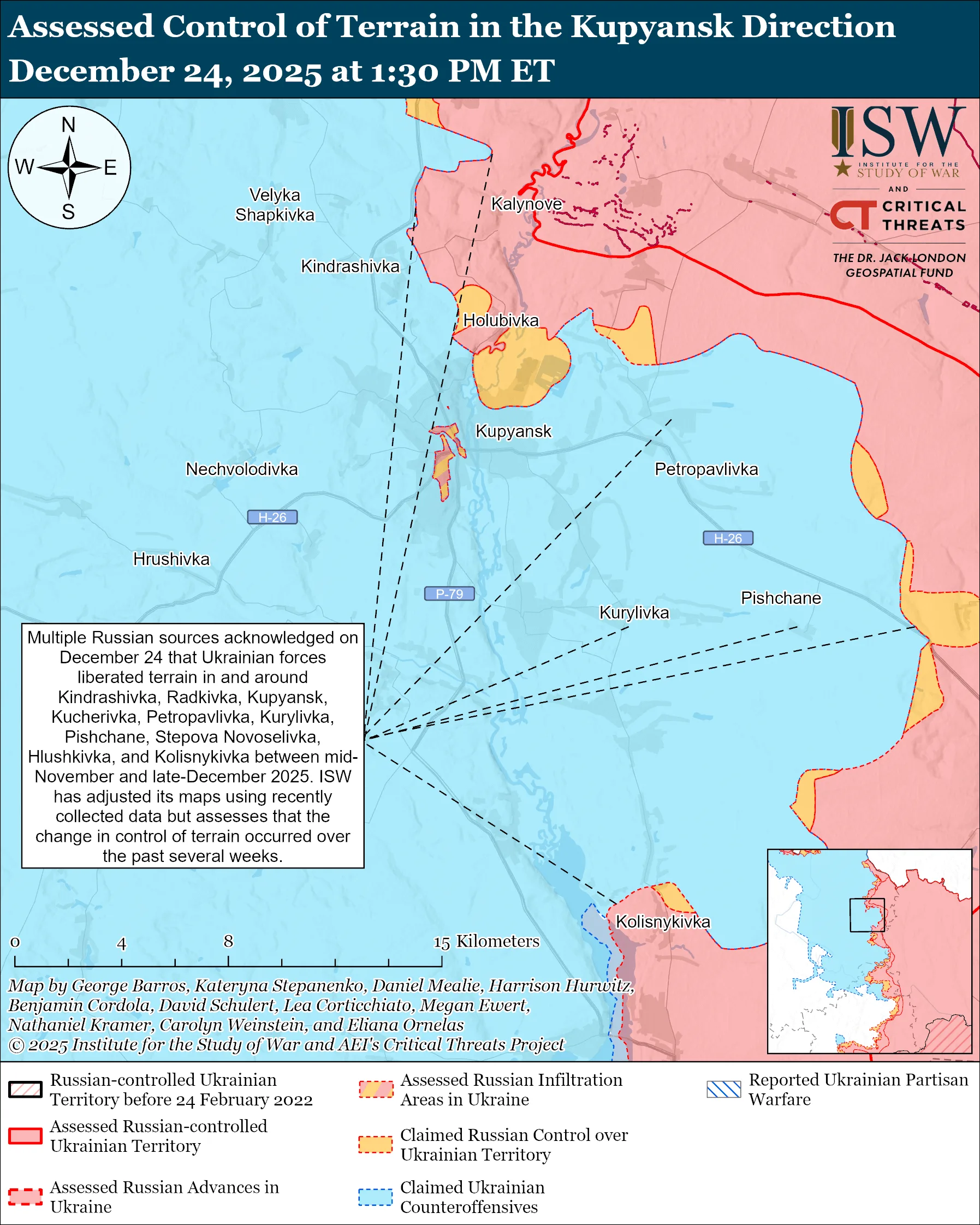
Kremlin-affiliated milbloggers are acknowledging significant Ukrainian successes in the Kupyansk direction and criticizing the Kremlin and the Russian military command for providing false battlefield reports. A Kremlin-affiliated Russian milblogger retroactively claimed on December 24 that Russian forces lost a significant part of their bridgehead on the west (right) bank of the Oskil River as Ukrainian forces regained positions immediately north and northwest of Kupyansk in Kindrashivka and Radkivka, and on the outskirts of Myrove on a prior unspecified date.[13] The milblogger noted that the three settlements were the only settlements that Russian forces controlled prior to the launch of Ukrainian counterattacks in recent weeks, despite Russian military officials claiming control over 11 settlements in the area. The milblogger published a refined map that refuted previous Russian claims and showed that Ukrainian forces maintained or regained positions north of Kupyansk in Dovhenke, southeast of Zapadne, and northeast of Kindrashivka; northeast of Kupyansk in the area northeast of Holubivka; east of Kupyansk in, northeast of, and southeast of Petropavlivka and in Kucherivka; southeast of Kupyansk in, northeast of, east of, and south of Pishchane and in Kurylivka; and south of Kupyansk in the area east and northwest of Kolisnykivka.[14] The milblogger criticized the Russian military command for exaggerating Russian gains in and around Kupyansk and for prematurely redeploying reserves from the Kupyansk direction to reinforce other frontline sectors, leaving the town vulnerable to Ukrainian infiltrations. The milblogger noted that the Russian military command similarly tried to exaggerate successes in the Siversk direction in 2024. Another Russian milblogger claimed, citing sources in the Russian 112th Motorized Rifle Brigade (1st Guards Tank Army [GTA], Moscow Military District [MMD]) and 16th Spetsnaz Brigade (Russian General Staff’s Main Directorate [GRU]), that Russian forces had “lost” Kupyansk and that Ukrainian forces cut off elements of the Russian 27th Separate Motorized Rifle Brigade (1st GTA) from their ground lines of communication (GLOCs).[15] A prominent milblogger involved in Russian crowdfunding efforts stated that local Russian reports suggest that Russian positions continue to deteriorate as Ukrainian forces achieved successes in Myrove, Radkivka, and Sobolivka (west of Kupyansk).[16] Russian milbloggers, therefore, have acknowledged that Ukrainian forces have liberated or maintained positions in 182.64 square kilometers in the Kupyansk direction since December 11.
 |


Comments