The Arguments of Same Sex Marriage-as Biracial Marriage
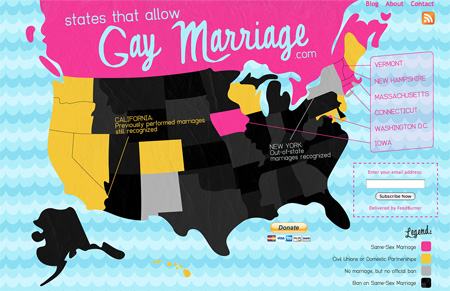
This blog has posted many times about the arguments made against biracial marriage and same sex marriage. On the first part of the article below we posted the 12 arguments by Courier Journal and their explanation of it. AF* also went to Wikipedia and pulled out similar arguments pro and against from those times.
So many years and so little has changed in the closed minds of people that like the world the way it is and change is seen as suspicious and bad. In every generation we have people that feel that way. We tend to keep what we learn from our parents, friends and the rest of our growing environment in our hearts and minds. But anybody can testify that not everything we learn was true. Particularly in this age of scientific discoveries both in space and in the rules of nature that govern us here on earth. We see doubt and we see changes.
Nothing stays the same. We don’t stay the same. We are born cute, small and soft and we die old and wrinkled, that is if we get through live out our years.
The main thing is and the compass anybody should go by is compassion and seeing people different than you as people just like you with the same needs, needs of protections and same rights. That never changes.
Courier-journal.com :
12 arguments made against both racial intermarriage and gay marriage
• It would be against nature and God.
• The Bible and Christian doctrine forbid it.
• It is contrary to legal history.
• The framers of the Constitution did not intend for it.
• Tradition and social customs forbid it.
• It runs counter to science and biology.
• Those who would marry (gays and blacks) are sexually promiscuous or immoral.
• Children of such marriages would be inferior and suffer social prejudice.
• Civil rights laws already provide adequate protection.
• Existing marriage laws are not discriminatory because they treat races/sexes equally.
• Such marriages would result in social harm.
• In a democracy, the issue is best decided by the majority via the legislature, rather than through appointed judges.
Source: Ruth A. Chananie-Hill, “Framing and Collective Identities in the Legal Setting: Comparing Interracial Marriage and Same Sex Marriage,” Southern Illinois University
• The Bible and Christian doctrine forbid it.
• It is contrary to legal history.
• The framers of the Constitution did not intend for it.
• Tradition and social customs forbid it.
• It runs counter to science and biology.
• Those who would marry (gays and blacks) are sexually promiscuous or immoral.
• Children of such marriages would be inferior and suffer social prejudice.
• Civil rights laws already provide adequate protection.
• Existing marriage laws are not discriminatory because they treat races/sexes equally.
• Such marriages would result in social harm.
• In a democracy, the issue is best decided by the majority via the legislature, rather than through appointed judges.
Source: Ruth A. Chananie-Hill, “Framing and Collective Identities in the Legal Setting: Comparing Interracial Marriage and Same Sex Marriage,” Southern Illinois University
The ‘slippery slope’ argument
• Interracial marriage:
“The next step will be that they demand a law allowing them to visit the parlors and drawing room of whites and to without restraint have free and unrestrained social intercourse with your unmarried sons and daughters.” — Kentucky Congressman William B. Read, 1874
Interracial marriage would lead to “the father living with his daughter, the son with the mother,” and the “Turk with the Mohommedan.” — Tennessee Supreme Court, 1872
• Gay marriage:
“Polygamy is inevitable if same-sex marriage becomes the law of the land ... we can no longer have prohibitions on incestuous marriage if they break the institution of natural marriage.” — Matt Barber, Liberty Counsel, 2012
“The next step will be that they demand a law allowing them to visit the parlors and drawing room of whites and to without restraint have free and unrestrained social intercourse with your unmarried sons and daughters.” — Kentucky Congressman William B. Read, 1874
Interracial marriage would lead to “the father living with his daughter, the son with the mother,” and the “Turk with the Mohommedan.” — Tennessee Supreme Court, 1872
• Gay marriage:
“Polygamy is inevitable if same-sex marriage becomes the law of the land ... we can no longer have prohibitions on incestuous marriage if they break the institution of natural marriage.” — Matt Barber, Liberty Counsel, 2012
The ‘God’ argument
• Interracial marriage:
“The right in the states to regulate and control, to guard, protect and control this God-given, civilizing and Christianizing institution is of inestimable importance … and cannot be surrendered.” — Indiana Supreme Court, 1871
• Gay marriage:
“God is the author of marriage, and we will not let an activist politician like Barack Obama, who is beholden to gay marriage activists for campaign financing, to turn marriage into something political that can be redefined according to presidential whim.” — Brian Brown, National Organization for Marriage, 2012
“The right in the states to regulate and control, to guard, protect and control this God-given, civilizing and Christianizing institution is of inestimable importance … and cannot be surrendered.” — Indiana Supreme Court, 1871
• Gay marriage:
“God is the author of marriage, and we will not let an activist politician like Barack Obama, who is beholden to gay marriage activists for campaign financing, to turn marriage into something political that can be redefined according to presidential whim.” — Brian Brown, National Organization for Marriage, 2012
The ‘unnatural’ argument
• Interracial marriage:
“Mating between the races is unnatural, and begets a resentment in the normal mind. It is incompatible to the continued being of the races, and is repugnant to their instincts.” — Kentucky Court of Appeals, 1904
• Gay marriage:
“Today the family is often threatened by legislation which — at times directly — challenges its natural structure, which is and must necessarily be that of a union between a man and a woman founded on marriage.” Family “must never be undermined by laws based on a narrow and unnatural vision of man.” — Pope John Paul II, 2005
“Mating between the races is unnatural, and begets a resentment in the normal mind. It is incompatible to the continued being of the races, and is repugnant to their instincts.” — Kentucky Court of Appeals, 1904
• Gay marriage:
“Today the family is often threatened by legislation which — at times directly — challenges its natural structure, which is and must necessarily be that of a union between a man and a woman founded on marriage.” Family “must never be undermined by laws based on a narrow and unnatural vision of man.” — Pope John Paul II, 2005
Support for
interracial marriage went from 4 percent in 1958 to
a record high 86 percent last year, according to a
Gallup poll.
interracial marriage went from 4 percent in 1958 to
a record high 86 percent last year, according to a
Gallup poll.
Half of all
Americans think
same-sex marriage should be recognized under the law as valid.
Americans think
same-sex marriage should be recognized under the law as valid.
WIkipedia: Loving Day in VA :

For interracial marriage Pic wikipedia
Despite the Supreme Court's decision, anti-miscegenation laws remained on the books in several states, although the decision had made them unenforceable. In 2000, Alabama became the last state to adapt its laws to the Supreme Court's decision, by removing a provision prohibiting mixed-race marriage from its state constitution through a ballot initiative. 60% of voters voted for the removal of the anti-miscegenation rule, and 40% against.[14]
After Loving v. Virginia, the number of interracial marriages continued to increase across the United States[15] and in the South. In Georgia, for instance, the number of interracial marriages increased from 21 in 1967 to 115 in 1970.[16]
[edit]For same-sex marriage
Loving v. Virginia is discussed in the context of the public debate about same-sex marriage in the United States.[17]
In Hernandez v. Robles (2006), the majority opinion of the New York Court of Appeals, that state's highest court, declined to rely on theLoving case when deciding whether a right to same-sex marriage existed, holding that: "[T]he historical background of Loving is different from the history underlying this case."[18] In the 2010 federal district court decision in Perry v. Schwarzenegger, which overturned California's Proposition 8 (which restricted marriage to opposite-sex couples), Judge Vaughn R. Walker cited Loving v. Virginia to conclude that "the [constitutional] right to marry protects an individual's choice of marital partner regardless of gender".[19]On more narrow grounds, the 9th Circuit Court of Appeals affirmed.[20][21]


Comments