Would There Be an anti Gay Marriage Amendment to The Constitution?
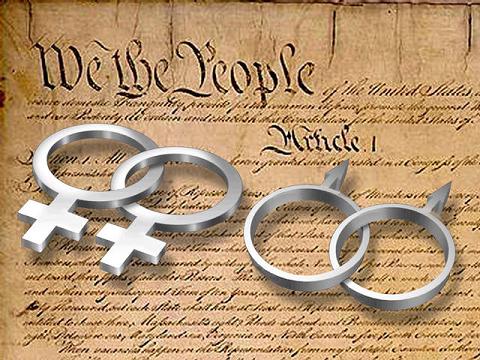
Opinion Written by Colin Warriner- Originally published on sosogay.org
I would forgive the majority of So So Gay’s readers for answering this question with a simple ‘no’. If the USA decides to insert a ban on same-sex marriage into its Constitution – its centremost document of government – most LGBT people in Britain would not be affected beyond feeling sympathy for their fellows across the Atlantic. It would be a pity, but a distant one.
It’s a question that has personal resonance for me, however: a naturalised citizen of the UK but an American also; my family all live in the States, and I may want to again as well some day. For me, and for our US readers, the possibility of a constitutional amendment defining marriage as existing solely between one man and one woman is a threat to our equality and future happiness. The threat has grown more real recently, with support for such an amendment being pledged by Mitt Romney, the former governor of Massachusetts and current frontrunner to challenge Barack Obama in the 2012 presidential election.
A proposed Federal Marriage Amendment has been a favourite idea of social conservatives in America for a few years: there have been efforts to introduce one in Congress since 2002. But is it something really worth worrying about? There are certainly good reasons to be optimistic that such a thing will not come to pass.
- Public opinion towards gay marriage in the US has been steadily improving for years. In fact, according to Gallup, 2011 marks the first time a majority of people polled said it should be held valid. The recent victory by same-sex marriage supporters in New York is another sign that the momentum in America is on the side of those seeking better rights for homosexual couples, not fewer.
- This most recent pledge to support a marriage amendment has been made by politicians angling to become the presidential candidate of the Republican Party. Republican primary voters are notably conservative, and making such a commitment could be a canny way for politicians to throw some red meat to the people who may put them on the road to the White House. There’s no way of telling if they would actually act on it if they ever made it into office. Romney’s words and actions are particularly worthy of scepticism. He cut a politically centrist figure as the Republican governor of a relatively liberal state, but has reversed his position on nearly every substantive issue since he began pursuing the presidency.
- It is also very difficult to amend the US Constitution. That was the intention of its authors, Founding Fathers, who recognised the need for government to evolve to suit changing circumstances, but did not want it to become subject to poorly conceived additions. After being proposed by two-thirds majorities in each chamber of the US Congress, it must be ratified by legislative bodies in three quarters of states. It is a tall order, especially when the US Senate is still controlled by the Democratic Party, which is largely opposed to a marriage amendment.
The likelihood of a constitutional ban on same-sex marriage therefore seems low. All the same, there is cause for concern. The conditions may not be right for such a thing to come to pass right now, but it is not impossible that they might become so.
- Republicans already have a majority in the US House of Representatives, albeit not a two-thirds one. If they were to have another election year like the one they had in 2010, with their support bolstered by American voters fed up with a stagnant economy, they could conceivably take control of both chambers of Congress and propose a federal marriage amendment.
- If Romney’s support grew and he were able to defeat President Obama in 2012, it is hard to know exactly what his policy on same-sex marriage would be, but he has been a consistent opponent of it in principle for years, and for political reasons he might plausibly follow through on his pledge (if a firebrand like Michele Bachmann – also a signatory – were to pull off an upset and win the nomination and election we can be more certain she would press for an amendment).
- Ratification in three quarters of states seems like a tough prospect until you look at how many have already banned gay marriage. Twenty-nine currently ban same-sex marriage in their own state constitutions. Some of those allow for civil and other equivalent unions, but 19 explicitly prohibit legal recognition for any non-heterosexual partnership. Add to them the states that currently ban gay marriage at just a statutory level and the ratification threshold of 38 states doesn’t seem out of reach.
We are therefore looking at a threat that is unlikely but not impossible. To write an amendment into the Constitution that limits – rather than extends or protects – freedom is a rarely attempted and even more rarely successful thing: the risk of it happening should not be overstated, especially with momentum seeming to favour gay rights. A lot of variables would have to come into alignment at the same time for same-sex marriage to be made unconstitutional.
But that doesn’t mean we should banish the threat entirely from our minds. When the men and women who want to lead the nation promise to legislate discrimination we shouldn’t give them a pass just because the promise will be difficult to keep. I bristle at the idea of allowing only one issue to determine my vote in an election that affects so many, but I find it hard to conceive of any circumstance in which I could support a candidate who openly pledged to deny me and my boyfriend the opportunities given to heterosexual couples, even if they knew as well as I do that they might never have to make good on it.
America has made real progress toward marriage equality. As assured as that progress may appear, we still need to stay vigilant and hold to account those politicians who would promise to undo it.


Comments