Despite Ron DeSantis Words, His Fight Against The Rainbow, Has Little to Do with Safety and Much About Anti Gay Attitude
Photo illustration by Slate. Photo by Getty Images Plus.
BY HENRY GRABAR
Slate
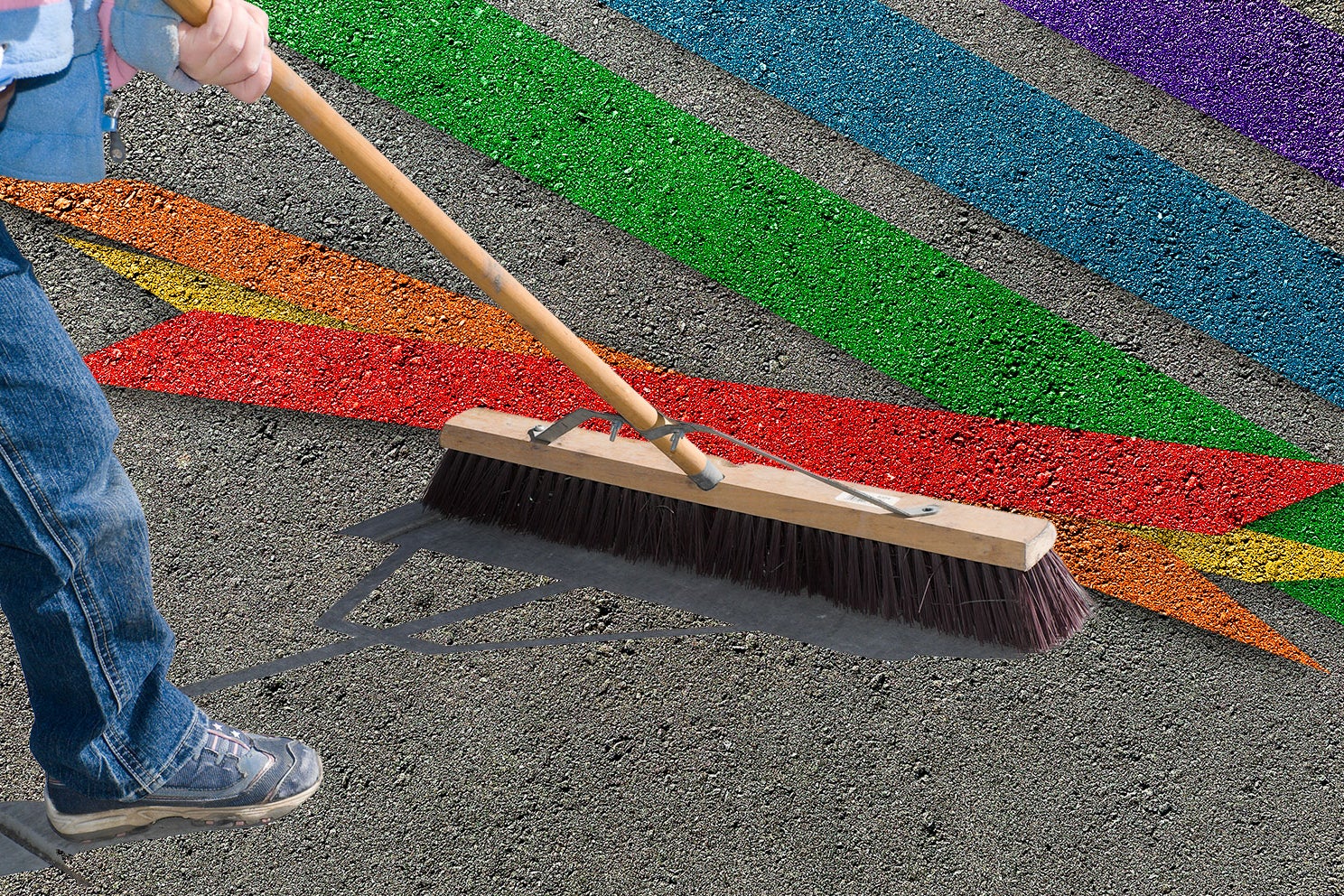
For days now, the Florida Highway Patrol has been stationed in the parking lot of an Orlando Dunkin’ Donuts. Their mission: Stop chalk-wielding activists from restoring a rainbow crosswalk that, until it was erased overnight by the Florida Department of Transportation two weeks ago, commemorated the 2017 mass shooting at the adjacent Pulse nightclub.
The state has already had to redo its black-and-white paint job once, after a local state senator helped redraw the brightly colored stripes. Since then, four people have been arrested on the rare charge of “interfering with a traffic control device” and charged with criminal felonies, according to lawyer Blake Simons, who represents the defendants. The state claims each chalker inflicted more than $1,500 in damage. “Chalking the crosswalk is obviously protected speech,” Simons told me, and added that he was “puzzled” at how the state arrived at those damages for chalk that washed away in the rain.
The grayscaling has since spread to other Florida cities, which have been directed to paint over roadway designs or forfeit transportation funding. Some, including Key West and Delray Beach, are fighting to keep their Pride-themed intersections. Hundreds of protesters gathered in Miami Beach and Fort Lauderdale this weekend to defend those cities’ brightly painted crosswalks. In Tampa, two (white) ministers were arrested for obstructing the demolition of a “Black History Matters” display. What might once have seemed like a cosmetic performance of virtue signaling from the urban revival starter kit has become a legitimate site of political resistance.
The controversy began at the end of June, when the Florida Department of Transportation issued a dry and technical memorandum about “non-standard surface markings” on roadways, which, it noted, “can lead to distractions or misunderstanding,” in particular for autonomous vehicles. Florida Gov. Ron DeSantis has said the wipeout of roadway messages was the result of an earlier state transportation bill, and has emphasized that he feels politics has no place in the roadway.
But the state’s 2025 transportation bill did not actually change Florida’s road-art policy, which has always permitted alterations with state approval—it only increased the penalties for noncompliance. The state’s crackdown also dovetailed with a similar note from U.S. Transportation Secretary Sean Duffy, who days later announced a federal initiative to wipe out roadway markings, saying on X that “Taxpayers expect their dollars to fund safe streets, not rainbow crosswalks. Political banners have no place on public roads.”
For most Florida Democrats, the cause for the state’s crosswalk-painting campaign is clear: Anti-gay animus. Miami-Dade County Mayor Daniella Levine Cava said the order “is about erasing people’s identity and taking over local government.” The mayor of Fort Lauderdale, Dean Trantalis, said at a public meeting last week that he did not buy the traffic safety excuse: “I’m sure that the state will find every way they can to associate their actions and to make it look like they’re trying to enforce traffic control mechanisms. But as it’s been said time and again, it’s simply a camouflage for their true intent, which is to erase and eliminate all or as many LGBTQ references in the state as possible.”
The deadline for those cities to erase their crosswalks or lose millions in state transportation funding is this week, but several have decided to appeal the order.
To be sure, not every painted crosswalk in Florida celebrates gay rights. Tampa erased 47 artworks including a “back the blue” mural, and Port St. Lucie got rid of a painted hearts memorial for a teenager who died in 2003. But those actions were undertaken by municipalities. It was only after the state’s erasure of the Pulse crosswalk generated stories from the Associated Press and on NPR that the state painted over the checkerboard crosswalks in Daytona Beach that paid tribute to the famous local NASCAR race. For the skeptics, it was as if the state was hastily claiming a piece of right-wing culture to quell accusations of bias. DeSantis previously antagonized gay rights groups in the state with the 2023 “Don’t Say Gay” law.
What makes the public safety rationale suspicious is that several of the projects had previously won safety accolades from the state DOT, including Tampa’s “crosswalks to classrooms.” Two Orlando fourth-graders who won a state-sponsored roadway safety contest in May will have their bike-lane paintings removed as well. Even the Pulse crosswalk had been repainted by the state just a couple of years ago.
City planners have long viewed such short-term, low-cost pieces of “tactical urbanism” as a way to help slow traffic and create safer streets. A 2022 study undertaken by Sam Schwartz for Bloomberg Philanthropies found double-digit crash declines around newly painted projects. Reporters from the Orlando Sentinel determined that the city’s own bright murals and decorative crosswalks increased foot traffic and lowered conflicts with vehicles along the city’s busy Orange Avenue. Delray Beach has reported a similar decline in accidents around its crosswalk mural.
Even if you’re skeptical about the true motivations, Florida’s sudden change of heart does reflect a long-standing philosophical divide between state and city officials on street design. Generally speaking, state traffic engineers view any roadway obstacle or distraction—even street trees!—as a safety risk for drivers. Cities have been constrained in their deployment of bike lanes, pedestrian infrastructure, and other projects that slow down traffic by a roadway design bible from the Federal Highway Administration called the MUTCD. Safe streets activists say those guidelines guard drivers’ time and security at the expense of pedestrians on roads like Florida’s US-19, the country’s most dangerous. So much so that the National Association of City Transportation Officials drafted its own countervailing “Urban Street Design Guide.”
But it’s hard to view Florida’s crosswalk crackdown as a bona fide public safety project. It comes at the same time as Duffy’s political order on roadway speech, and on the heels of the GOP Congress forcing D.C. to demolish its Black Lives Matter mural. If that mural’s installation, in the summer of 2020, felt to some like a folly of liberal exuberance, its demolition at a time of constant attacks on Black workers as unqualified and unworthy was a sinister portent.
Meanwhile, DeSantis’ attack on the public right-of-way as a venue for political expression is not just about paint. It’s of a piece with previous GOP efforts to criminalize and endanger demonstrators marching in the street. Those include a Florida law that, DeSantis claimed during the “No Kings” protests in June, permits drivers to hit protesters if the drivers believe themselves to be fleeing for their own safety.
The urban planner Mike Lydon, who coined the term “tactical urbanism” and advises jurisdictions on projects, told me the purpose of such artwork wasn’t necessarily in the final result. “When a group is looking to represent their culture, themselves, in the street, it can be very powerful to do that,” he said.
It is the rare participatory process where everyday people, even children, can physically participate in designing the place where they live. Choosing a message is important, but so is inscribing it in the asphalt. It’s a process that says: This place belongs to us. And when it gets removed, it says the opposite.


Comments