Gay Teens Fight The Monster Created By Homophobia
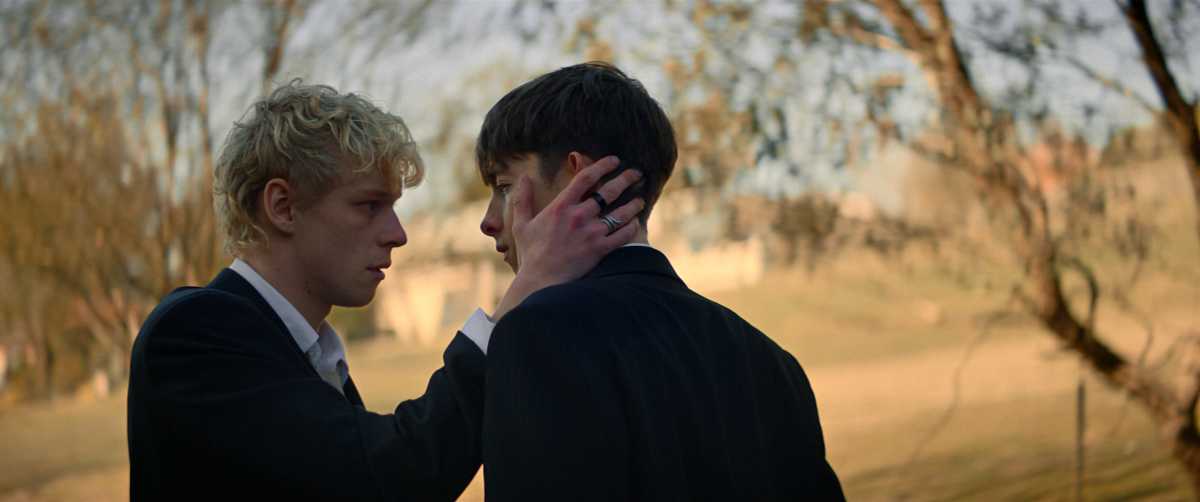 |
If “Leviticus” becomes a hit, one hopes that it might create space for further queer voices in horror. NEON |
GCN
Steeped in loneliness, queer director Adrian Chiarella’s “Leviticus” is set in a dusk of the soul. The film’s look reeks of depression. Taking place in a small Australian town where standing in line at a deli is one of the few leisure options, it turns the countryside into a manmade void. (Chiarella says “we purposefully set the film in a regional town where there’s this industrial boneyard of old factories that was built around a church.”) Its lighting glares with shades of yellow that don’t come from the sun. The score creates tension with a steady hum of electronic buzzing. Institutions like school, organized religion, and their families have failed its protagonists, gay teenagers Naim (Joe Bird) and Ryan (Stacy Clausen).
A girl is attacked by an unseen force while taking a shower. The audience can see her head but can’t understand the meaning of the sounds we hear till it’s too late. Her parents had brought her to a conservative Christian church, which dominates their town, because she was attracted to other girls. Naim and Ryan secretly hang out in a decrepit mill, sharing a joint and kissing each other. When Naim spies Ryan with the local pastor’s son, he gives away the secret of Ryan’s gayness. The preacher calls in a witch — although he’d never see it in those terms — to deal with queer youth the way it does customarily: placing them under a spell which leads them to be attacked by evil doppelgangers of their lovers. It’s a supernatural method of enforcing isolation. These entities aren’t just a form of psychological torture. As shown as the start, they can commit murder.
David Robert Mitchell’s “It Follows,” where a monster that hunts down people after sex can take the form of their relatives, stayed on my mind during “Leviticus.” Chiarella’s film is a lot less open-ended. Where “It Follows” sets its characters in a social sphere, “Leviticus” plops them into a near-void. Paranoia is its governing mood. Evil Ryan convincingly acts friendly, then shoves his fist into Naim’s mouth.
Depicting the impact of intense homophobia so directly risks making gayness itself look like a path to misery and loneliness. (This charge has been leveled against “Brokeback Mountain” since its release.) In a battle between romance and gloom, the latter comes out ahead. “Leviticus” is so devoted to it that the mood becomes a bit monotonous. Although the reasons why are obvious, there are few light moments for Naim and Ryan. Even the brightest parts of their relationship are impossible for them to fully enjoy. The desire for escape overwhelms them. They feel safe enough to have sex while riding in the back seat of a bus.
If the spell is an allegory for conversion therapy, the film’s metaphors are more ambiguous than they might look on first glance. Using horror as a filter allows it to treat real-life darkness without a 1:1 correlation. Naim’s mother turns out to be another example of a monster taking human form while professing love. Near the film’s end, she alienates him forever by telling him that she wants him to be alone even after she’s dead. While this may be unintentional, watching two lovers beat each other bloody suggests intimate partner violence. The conflicts of Naim and Ryan’s relationship feed into the monster that threatens them.
When I saw “Leviticus” in early June, two horror films topped the US box office the previous weekend: Kane Parsons’ “Backrooms” and Curry Barker’s “Obsession.” Both have become cultural phenomena, not just hits. Horror is one of the few places where one can work without stars, on a fairly low budget, and have a shot at reaching a wide audience. It’s also a genre rooted in the work of queer writers and filmmakers: Mary Shelley, Bram Stoker, James Whale, F. W. Murnau. Yet its rise to respectability over the last decade has left that heritage out of the picture. Exceptions, such as Tina Romero’s “Queens of the Dead” and trans director Alice Maio Mackay’s work, haven’t made it to a large audience. Neon will open “Leviticus” in wide release, so it’ll play the American counterparts of its dismal setting. If it becomes a hit, one hopes that it might create space for further queer voices in horror.


Comments