A Few Take Aways From The Supreme Ct. Decision on Tariffs (Tax on Consumers)
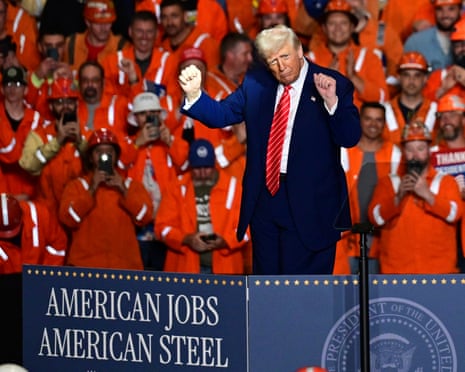 |
| Trump dance. Shy not dance he was getting a cut on nations that wanted to keep their Tarrifs low. Now you know why congress and not one person as the President manages the purse to use a constitutional word. Who would dance for getting money without workin g for it and Trump says is the poor on SS and SSI. The main media covered this issue in a very bad unfair way to the consumers. People still argue about tariffs not being taxes, if they are not taxes what are they? The media's fault since Trump's first four years. There should be rules that the Press should not be allowed on Airfare one and socially bingo with these people.They seem afraid they will be back listed and they will, but why did these people went into journalism? To make a Demented President happy? |
The Supreme Court’s landmark ruling on Friday invalidating many of the tariffs imposed by President Trump had wide-ranging economic, constitutional and political ramifications, and drew a scathing response from Mr. Trump.
Here are six takeaways from the decision and the reaction to it.
It was a big loss for the president.
The 6-3 ruling by the justices was a stinging defeat for Mr. Trump and a relatively rare instance of the court imposing a check on efforts in his second term to expand presidential power. Mr. Trump had repeatedly cast the tariffs as essential to his agenda, and his loss at the court will affect not only trade but his entire economic and foreign policy approach — he has repeatedly used tariffs, and the threat of them, to bludgeon both adversaries and allies.
Mr. Trump reacted with fury, assailing the justices who voted against the administration’s position as “fools and lap dogs,” and suggesting that they had bowed to foreign influence. But he quickly made plans to impose new rounds of tariffs using other mechanisms that are still available to him, though he will do so subject to much tighter constraints on his power.
The Supreme Court showed its independence.
Since Mr. Trump took office a year ago, the Supreme Court has handed him a string of victories that cleared the way, at least temporarily, for many of his administration’s most aggressive policies on immigration, the independence of government agencies and transgender military troops.
The tariff decision was the first time the court had issued a merits decision, a final decision squarely on the legality of one of Mr. Trump’s second-term executive actions. It marked a muscular show of independence by Chief Justice John G. Roberts Jr., who wrote the majority opinion striking down the president’s expansive tariffs. Two of the three conservative justices appointed by Mr. Trump during his first term, Justices Amy Coney Barrett and Neil M. Gorsuch, joined the chief justice in rejecting the president’s signature economic policy.
Despite Mr. Trump’s angry response to the ruling, he gave no indication that he would not abide by it.
Image
Mr. Trump on Friday criticized the court’s action but gave no indication he would not abide by it.Credit...Tierney L. Cross/The New York Times
It’s unlikely to have an immediate or big effect on prices.
The tariffs struck down by the court had put upward pressure on the price of a wide variety of goods made in other countries, including furniture, apparel and electronics. But the ruling seemed unlikely to bring down prices right away, if at all, economists said. Mr. Trump is already moving to impose new tariffs using different legal authorities, and companies that raised prices to offset import duties seem unlikely to reduce them, especially if tariff rates remain uncertain.
Major global trading partners were cautious.
The muted response to the Supreme Court ruling from trading partners around the world highlighted that, in capitals from Ottawa to New Delhi, officials knew that the decision would not spell the end of Mr. Trump’s tariff policies.
In Canada and Mexico, the two nations that currently enjoy the lowest effective tariff rates because of a North American pact, the decision itself did not have a significant impact. But Mr. Trump’s statement during his news conference, that he plans to turn to a new mechanism to impose a 10 percent global tariff, could leave them worse off than before the Supreme Court ruling.
The European Union, too, stopped short of celebrating the decision and instead said, through a spokesman, that it would “remain in close contact with the U.S. Administration as we seek clarity on the steps they intend to take in response to this ruling.”
There’s new uncertainty for the federal budget.
While President Trump’s tariffs have struggled to revitalize U.S. manufacturing or shrink the trade deficit, they have succeeded in creating a new source of revenue for the heavily indebted federal government. And it’s now unclear what will come of that funding stream.
Before the Supreme Court ruling, Mr. Trump’s tariffs were expected to raise about $3 trillion in revenue over the next nine years, according to the nonpartisan Congressional Budget Office. The Supreme Court ruling threw out tariffs responsible for roughly half of that revenue, economists said, with the Yale Budget Lab estimating the impact at about $1.5 trillion. But Mr. Trump later on Friday said he would impose a new set of levies, including a 10 percent across-the-board tariff, that would more than make up the difference.
“The end result is going to get us more money,” Mr. Trump said.
It left unsettled how the government would issue refunds.
The ruling raised the prospect that the administration may have to refund more than $100 billion in tariff revenue to thousands of importers, though it provided no guidance on how that process should play out. Trade lawyers and others said there will likely be months or years of court fights and administrative proceedings as companies seek to recoup the import duties on the tariffs struck down by the justices.
The court left it to lower courts and the U.S. Court of International Trade to initiate the refund process, which will be carried out by Customs and Border Protection and the Treasury Department. Importers who paid the tariffs are the only ones who are directly eligible for refunds, but other businesses that had to absorb the costs could also seek reimbursement through lawsuits. It’s also unclear whether or how consumers could be compensated for higher prices they paid.
The ruling is unlikely to have an immediate effect on prices. Don't be surprised to the states send Trump a B ill for How much it cost their consumers :About $1700 person which it what it cost you.


Comments