November 16, 2009

Decapitated because he was gay in Puerto Rico


GAY PUERTO RICAN TEEN DECAPITATED, DISMEMBERED, AND BURNED


Over the weekend the brutalized body of gay teen George Steven Lopez Mercado was found by the side of a road in Puerto Rico. The police investigator suggested that he deserved what he got because of the "type of lifestyle" he was leading.

According to an iReport by Chrisopher Pagan: "On November 14 the body of a gay 19 year old was found a few miles away from the town in which he was residing in called Caguas. He was a very well known person in the gay community of Puerto Rico, and very loved. He was found on the site of an isolated road in the city of Cayey, he was partially burned, decapitated, and dismembered, both arms, both legs, and the torso. This has caused a huge reaction from the gay community here, but its a difficult situation. Never in the history of Puerto Rico has a murder been classified as a hate crime. Even though we have to follow federal mandates and laws, many of the laws in which are passed in the USA such as Obama’s new bill, do not always directly get practiced in Puerto Rico. The police agent that is handling this case said on a public televised statement that 'people who lead this type of lifestyle need to be aware that this will happen'. As If the boy murdered Jorge Steven Lopez was asking to get killed..."

Here's a report on the murder (in Spanish) from PrimeraHora.com. Said activist Pedro Julio Serrano: "It is inconceivable that the investigating officer suggests that the victim deserved his fate, like a woman deserves rape for wearing a short skirt. We demand condemnation of this investigator and demand that Superintendente Figueroa Sancha replace him with someone capable of investigating this case without prejudice." (my translation, please suggest a better one if you can).

POSTED 8:49 AM EST BY ANDY TOWLE IN CRIME, NEWS, PUERTO RICO | PERMALINK

November 12, 2009

He got his, I got mine...they were not able to touch my face, but they tried to destroy my car. No arrests, no action even though is classified as a"


ANOTHER HATE CRIME. I you don't know this person in Ontario, but you know me...then you know somebody who was given the same verbal diatribe and then violence!

ONTARIO MAN JUMPS FROM MOVING TRUCK TO ESCAPE GAY BASHER


Another gay bashing in Ontario, Canada, this one in the city of London, happened less than a week after Jake Raynard was beaten by a gang in Thunder Bay.

Xtra reports:

"Brandon Wright, an event manager and modelling agent, says a man who called himself Alex approached him online via instant messenger. The man told Wright he was an aspiring model looking for work. Wright arranged to meet Alex near a variety store on Kipps Ln near Adelaide St in London. After meeting, Wright told the man that he wouldn’t be able to help him find a modelling job. 'He just didn’t have the looks for it,' says Wright. The man then told Wright that he wanted to show him something in his truck. When Wright climbed into the passenger side he says the man said, 'Because you’re gay you need to be punished. I’m going to fucking kill you and you’re a faggot.' The man then drove off with Wright still in the passenger seat. 'He started hitting me with a big, black, heavy object,' says Wright. 'He kept repeating, 'I’m going to fucking kill you faggot.'' Wright says the attack continued even while the man was driving. Wright jumped out of the moving truck to escape."

Wright says he was helped by bystanders. Police say they have a lead on the subject, who reportedly said he was from Thunder Bay.

Guess what...we are all human..straight couples vs gay couples

Study Shows Similarities Between Same- and Opposite-Sex Couples
November 5, 2009 5:07PM
Michael Cole
This post from HRC Family Project Director Ellen Kahn reflects on the new study showing similarities between same- and opposite-sex couples:
As a teenager, I never imagined my life would resemble that of my parents. No, as a “baby dyke,” marriage was out of the question, and kids… well I certainly did not think gay people ever had chidren. The idyllic life of a house with a picket fence was for other people, not me. And back then, I was perfectly content knowing that my life would indeed be “non-traditional” as long as it meant I could be myself.
My partner, however, recalls a different experience in her early adulthood. Her parents were very happily married (ultimately for 45 years) and she wanted a relationship like theirs, and she wanted to raise children. For her, coming out as a young adult was liberating, but she was deeply saddened to know that she may lose the chance to have what he parents had. For both of us, and for thousands of others who came out in “our generation,” 30 years ago, it was not easy to imagine that we would marry our true love, have children, and blend into a neighborhood of other “straight” couples doing the same thing. Marriage wasn’t for us — raising children wasn’t for us, it was for someone else. And whether we wanted to let go of our own dreams of that seemingly idylllic life or not, it was easier on the psyche to do so.
Fast forward to this moment. Earlier this week, a report released by the Williams Institute shows us a completely different reality, and a very hopeful one for the young people who are coming out now. We can and do “couple” like our parents. We can and do have children, and we see ourselves as “just as married” as other couples even when the laws of our state or jurisdiction do not legally recognize us. You might say that we have changed the definition of marriage simply by claiming it for ourselves and not just sitting back to wait for the “powers that be” to tell us we are married. As someone once said, “if it looks like a duck, and walks like a duck, it’s a duck.” If we commit ourselves to another person and establish a household together, if we are raising children together or choosing not to, and if we are caring for one another and supporting one another through the joys and challenges of life, we are married. It’s that simple.
For me it is heartening to know that couples everywhere, and particulary in some unfriendly territory have made marriage theirs. After all, marriage — or whatever you might prefer to call the experience of being in a long-term committed relationship and sharing a household together — is a lifestyle, or a way of life that many of us want, and we should indeed make it ours.
Clearly not everyone has caught up to us. Tuesday’s outcome in Maine is a real and painful example of that. So while we continue to live our lives openly and strive toward the idyllic life we want for ourselves and our families, the hard truth is that we are not really “just like them.” We are not just like our parents or like John and Mary next door. Because it is still a very radical and threatening notion that two women or two men can “have what they have.” It’s not easy, and sometimes not safe, to hold my partner’s hand in public. It’s often anxiety-producing when we take our children to a new doctor or to meet the parents of a new friend. So while we know in our hearts that our relationships and our families are just as “real” as others, we are still facing legal and social obstacles. We are a brave and determined people, as evidenced by the findings in the report. Let’s continue to name our “spouses, husbands, wives and partners.”
Overall, the recent Census data has given a clearer picture of the diversity and broad geographic distribution of the LGBT community. For instance, one in six same-sex couples live in rural areas and one in four same-sex couples are non-white. It’s imperative that we continue telling our stories and part of that is standing up to be counted in the census. Learn more about the ”Our Families Count” project, a public education campaign (of which The Williams Institute and HRC are both a part) to encourage LGBT people to participate in the 2010 U.S. Census.

November 10, 2009

House Version of Health Bill is Gay inclusive

On Nov. 7, The House of Representatives approved a health care reform bill that would correct many of the problems that afflict health care in America. That bill, now headed for the Senate, contains provisions that would rectify inequities and extend better medical care to GLBT Americans and their families.

The House version included several items that had been lobbied for by GLBT equality advocates, including a change in tax laws that penalize gay and lesbian families who receive partnership benefits through their employers. As reported in the New York Times, the 1996 "Defense of Marriage" Act (DOMA) specifies that same-sex families cannot be recognized under federal law.

Thus, the value of such health benefit packages is taxed as income. This effectively has added an additional financial burden to gay and lesbian families that their heterosexual counterparts do not face.

The article quoted the member of the House who had introduced language to correct the situation, Washington Rep. Jim McDermott, a Democrat. McDermott said that the provision would "correct a longstanding injustice, end a blatant inequity in the tax code and help make health care coverage more affordable for more Americans."

"I meet people all the time who are gratified they work for companies that offer domestic partner benefits," Joe Solmonese, president of the Human Rights Campaign, told the Times. "But they pass on the benefits because they cannot afford the taxes that go with the benefits."

The HRC’s website detailed several legislative provisions included in the bill for which the equality organization had lobbied for years. Among those provisions is language that denotes GLBTs as a "health disparities population" and provides research funds to look into the ways in which sexual orientation and gender identity impact access to health care.

Also, there is a provision in the House version to provide early Medicaid support for mediations to treat HIV early, rather than waiting for the virus to lead to AIDS, in which patients’ immune systems have been so badly ravaged that they are susceptible to infections and opportunistic disease. Early treatment has been shown to be crucial in keeping people living with HIV healthier and able to survive for considerably longer periods of time than when treatment is delayed.

The bill also contains provisions for comprehensive sex education that would teach abstinence but also provide accurate information about how to prevent STD transmission, including HIV.

The issue of medical discrimination against GLBTs is also covered, in a provision that requires health providers to care for GLBT patients with the same level of professionalism and dedication that is shown toward heterosexual patients.

Whether those provisions will be part of any final bill that is sent to President Obama for signing remains to be seen. GOP Senate leaders have denounced the current version of the bill.

South Carolina Republican Sen. Lindsey Graham pronounced the bill "dead on arrival," while independent Sen. Joe Lieberman said that he could not endorse the House version of the bill "as a matter of conscience," the Associated Press reported.

House Version of Health Bill is Gay Inclusive
by Kilian Melloy
Monday Nov 9, 2009

November 8, 2009

My Gaydar also goes off..But then we know that some closeted gays have been the ones that persecute us.

FRIDAY, NOVEMBER 6, 2009

Dan Savage: "President Obama is a fierce advocate of gay rights the same way I'm a ladies' man. He isn't, and I'm not."
Posted by John Aravosis (DC) at 1:29 PM
Wow. Dan went on Olbermann last night, and was absolutely amazing. Interestingly, the first part of the segment shows Marc Mutty, the chairman of the anti-gay forces in Maine, who also works for the Catholic church up there. Had I met Mutty as a stranger on the street, I'd have been absolutely positively convinced that he was gay. I'm not saying Mutty is gay at all - I have no idea what his sexual orientation is. I just find it queer that so many of these anti-gay activists, like Mutty and Tony Perkins at the Family Research Council, among others, set off my gaydar to such an extent. It's just interesting.
gayamericablog

November 5, 2009

The banks took the $ and the economy, now they take the vaccine first.

Amid shortage, big NYC firms get swine vaccine
Rules allow company docs to request vaccine, distribute to high-risk groups

NEW YORK - Some of New York City's largest employers — including Wall Street firms like Goldman Sachs and big universities — have started receiving doses of the much-in-demand swine flu vaccine for their at-risk employees.

The government-funded vaccine is being distributed to states, where health departments decide where to send the limited doses. In New York, health officials are allowing businesses with onsite medical staff to apply for the vaccine.

Doctors for large companies can ask for the vaccine along with other doctors but must agree to vaccinate only high-risk employees like pregnant women and those with chronic illnesses, said Jessica Scaperotti, a spokeswoman for New York City's Department of Health and Mental Hygiene.

Last month, the city began offering vaccine to schoolchildren, as well as pediatricians and obstetricians who asked for it. Scaperotti said only half of the pediatricians in New York City have requested vaccine

"As the vaccine became more available we expanded it to adult providers," Scaperotti said. She called the large employers "a great avenue for vaccinating people at risk."

But a critic said Wall Street firms shouldn't have access to the vaccine before less wealthy Americans.

"Wall Street banks have already taken so much from us. They've taken trillions of our tax dollars. They've taken away people's homes who are struggling to pay the bills," union official John VanDeventer wrote on the Service Employees International Union Web site. "But they should not be allowed to take away our health and well-being."

The union has about 2 million members, including health care workers.

Vaccine in short supply
The swine flu vaccine has been in short supply nationwide because of manufacturing delays, resulting in long lines at clinics and patients being turned away at doctor's offices. The vaccine started trickling out in early October, and there are now nearly 36 million doses available.

The Centers for Disease Control and Prevention does not review and sign off on the decisions of state and city health departments as to which doctor's offices and businesses will be sent vaccine doses, said spokesman Tom Skinner.

The CDC director, Dr. Thomas Frieden, however, did send a letter Thursday to state and local health departments asking them to review their distribution plans and make sure the vaccine is getting to high-risk groups. Frieden said any decisions that appear to direct vaccine outside priority groups "have the potential to undermine the credibility of the program."

The agency has set guidelines on which patients should be at the front of the line: children and young people through age 24, people caring for infants under 6 months, pregnant women, health care workers and adults with health conditions such as asthma and diabetes.

Swine flu — which scientists call the 2009 H1N1 strain — is widespread throughout the country now, much earlier than seasonal flu usually hits.

Goldman Sachs has received 200 doses and Citigroup has received 1,200, health officials said. So far, 800,000 doses have been delivered to 1,400 health care providers in New York City, including public schools, pediatricians and hospitals.

In statements, Citigroup and Goldman Sachs said the vaccine would only go to those in high-risk groups.

"Goldman Sachs, like other responsible employers, has requested vaccine and will supply it only to employees who qualify," said spokesman Ed Canaday.

Morgan Stanley received 1,000 doses of the vaccine for its New York and suburban offices, but turned over its entire supply to local hospitals when it learned it received shipments before some area hospitals, spokeswoman Jeanmarie McFadden said.

Some New York pediatricians' offices that have gotten vaccine say the supply is not meeting the demand.

Manager Linda O'Hanlon at Uptown Pediatrics in Manhattan, said her office has received 500 doses so far — not enough for a practice with almost 7,000 patients.

"We have about 800 appointments" set up for patients who want to get vaccinated, she said.

October 28, 2009

A Hate crimes calls meF*** Fagget come out and see your car being destroyed

On Friday October 23 on the way to my car, I was assaulted in the private parking lot of my building. F***Fagget was what was repeated by one guy and his brother. Not tenants in my building, but they come and go freely somehow.
On Sunday October 25, I heard a diatribe of fucking fagget out of my window. These two guys were calling me to watch as they destroyed my car.
More to come when they get apprehended. Hate Crimes Task Force is investigating. Can say much more now.

October 24, 2009

How do you feel if you were follow to see if you picked up after your dog??

I picked up this story at the NYTimes. It made sense to publish it now that these days in which more and more police and private cameras cover our moves in this city; There are people asking for more, because of fear to crime and terror. On the other hand there many on the other side asking for their right to privacy. Where do you stand???????????AG

Constant Surveillance Rankles Britons

By SARAH LYALL
Published: October 24, 2009
POOLE, England — It has become commonplace to call Britain a “surveillance society,” a place where security cameras lurk at every corner, giant databases keep track of intimate personal details and the government has extraordinary powers to intrude into citizens’ lives.

Andrew Testa for The New York Times
Jenny Paton with her daughters Thea, left, and Esme last month at their home in Poole. A school application by a third and youngest daughter set off a local council's surveillance of the family.

A report in 2007 by the lobbying group Privacy International placed Britain in the bottom five countries for its record on privacy and surveillance, on a par with Singapore.

But the intrusions visited on Jenny Paton, a 40-year-old mother of three, were startling just the same.

Suspecting Ms. Paton of falsifying her address to get her daughter into the neighborhood school, local officials here began a covert surveillance operation. They obtained her telephone billing records. And for more than three weeks in 2008, an officer from the Poole education department secretly followed her, noting on a log the movements of the “female and three children” and the “target vehicle” (that would be Ms. Paton, her daughters and their car).

It turned out that Ms. Paton had broken no rules. Her daughter was admitted to the school. But she has not let the matter rest. Her case, now scheduled to be heard by a regulatory tribunal, has become emblematic of the struggle between personal privacy and the ever more powerful state here.

The Poole Borough Council, which governs the area of Dorset where Ms. Paton lives with her partner and their children, says it has done nothing wrong.

In a way, that is true: under a law enacted in 2000 to regulate surveillance powers, it is legal for localities to follow residents secretly. Local governments regularly use these surveillance powers — which they “self-authorize,” without oversight from judges or law enforcement officers — to investigate malfeasance like illegally dumping industrial waste, loan-sharking and falsely claiming welfare benefits.

But they also use them to investigate reports of noise pollution and people who do not clean up their dogs’ waste. Local governments use them to catch people who fail to recycle, people who put their trash out too early, people who sell fireworks without licenses, people whose dogs bark too loudly and people who illegally operate taxicabs.

“Does our privacy mean anything?” Ms. Paton said in an interview. “I haven’t had a drink for 20 years, but there is nothing that has brought me closer to drinking than this case.”

The law in question is known as the Regulation of Investigatory Powers Act, or RIPA, and it also gives 474 local governments and 318 agencies — including the Ambulance Service and the Charity Commission — powers once held by only a handful of law enforcement and security service organizations.

Under the law, the localities and agencies can film people with hidden cameras, trawl through communication traffic data like phone calls and Web site visits and enlist undercover “agents” to pose, for example, as teenagers who want to buy alcohol.

In a report this summer, Sir Christopher Rose, the chief surveillance commissioner, said that local governments conducted nearly 5,000 “directed surveillance missions” in the year ending in March and that other public authorities carried out roughly the same amount.

Local officials say that using covert surveillance is justified. The Poole Borough Council, for example, used it to detect and prosecute illegal fishing in Poole Harbor.

“RIPA is an essential tool for local authority enforcement which we make limited use of in cases where it is proportionate and there are no other means of gathering evidence,” Tim Martin, who is in charge of legal and democratic services for Poole, which is southwest of London, said in a statement.

The fuss over the law comes against a backdrop of widespread public worry about an increasingly intrusive state and the growing circulation of personal details in vast databases compiled by the government and private companies.

“Successive U.K. governments have gradually constructed one of the most extensive and technologically advanced surveillance systems in the world,” the House of Lords Constitution Committee said in a recent report. It continued: “The development of electronic surveillance and the collection and processing of personal information have become pervasive, routine and almost taken for granted.”

The Lords report pointed out that the government enacted the law in the first place to provide a framework for a series of scattershot rules on surveillance. The goal was also to make such regulations compatible with privacy rights set out in the European Convention on Human Rights.

RIPA is a complicated law that also regulates wiretapping and intrusive surveillance carried out by the security services. But faced with rumbles of public discontent about local governments’ behavior, the Home Office announced in the spring that it would review the legislation to make it clearer what localities should be allowed to do.

“The government has absolutely no interest in spying on law-abiding people going about their everyday lives,” Jacqui Smith, then home secretary, said.

One of the biggest criticisms of the law is that the targets of surveillance are usually unaware that they have been spied on.

Indeed, Ms. Paton learned what had happened only later, when officials summoned her to discuss her daughter’s school application. To her shock, they produced the covert surveillance report and the family’s telephone billing records.

Could this be what Gates said about a more humane in enforcing DADT?

Could ruling relax 'Don't Ask' without law change?
Source: DOD examining Witt as way to ease enforcement
By CHRIS JOHNSON | Oct 24 2009, 8:09 AM

The Defense Department is examining whether a ruling in a lawsuit challenging “Don’t Ask, Don’t Tell” could be used to relax enforcement of the policy without changing the law, according to a Senate aide.

The Pentagon “is looking carefully” at the 9th Circuit Court of Appeals ruling last year in Witt v. Air Force “to see if there are any nationwide implications beyond the Ninth Circuit,” said the aide, who spoke to the Washington Blade on condition of anonymity.

The ruling challenged the U.S. military to prove that the presence of Maj. Margaret Witt, a lesbian nurse who was discharged under “Don’t Ask, Don’t Tell” after serving in the Air Force for 18 years, was detrimental to unit cohesion.

The 9th Circuit remanded the case to district court for further consideration last year in light of protections granted by the U.S. Supreme Court’s 2003 ruling in Lawrence v. Texas.

“It does not appear that there are” nationwide implications to the ruling, the aide said. “However, given the higher standard that applies for the 9th Circuit, [it] could be relevant across the country.”

The aide continued: “Given the fact that [Defense] Secretary [Robert] Gates has publicly said we’re going to look for humane ways to do this, clearly, the higher standard established in the Ninth Circuit provides some guidance on how to do that.”

Doug NeJaime, a gay associate professor at Loyola Law School, Los Angeles, said the Witt case “could be a way to keep ‘Don’t Ask, Don’t Tell’ on the books, but enforce it in a way that actually effects a much less significant number of people.”

NeJaime said Witt is an as-applied challenge, meaning the 9th Circuit considered “Don’t Ask, Don’t Tell” as a way to further government interests to maintain unit cohesion.

But the 9th Circuit disputed that notion in its ruling, and said in a footnote that it’s not Witt’s sexual orientation that undermines unit cohesion, but the process of discharging her from her unit.

NeJaime said if the U.S. military used this standard in its enforcement of “Don’t Ask, Don’t Tell,” the law could be applied “in a more case-by-case” basis and examine whether the discharge of each service member actually inhibited unit cohesion.

“So, if [discharging] actually undermines unit cohesion … then you wouldn’t discharge,” NeJaime said. “So, I mean, it could allow for a much more forgiving ‘Don’t Ask, Don’t Tell’ policy.”

This application of “Don’t Ask, Don’t Tell” seems to be consistent with remarks Gates made in June, when he said he’s looking for a “more humane” way to implement the law, as well as whether there is any “flexibility” in applying it.

"Let me give you an example,” he said at the time. “Do we need to be driven when the information, to take action on somebody, if we get that information from somebody who may have vengeance in mind or blackmail or somebody who has been jilted?"

Cynthia Smith, a Pentagon spokesperson, didn’t respond to a request for comment on whether the Defense Department was looking at the Witt case as a way to mitigate “Don’t Ask, Don’t Tell.”

But in an earlier e-mail, Smith confirmed that officials were consulting with legal experts to find a different way to apply the law.

“The Secretary has asked the DOD General Counsel to review the law to determine if there is any flexibility in how this law is applied,” she said. “This action is still currently being reviewed by the [Office of the General Counsel.]”

Smith said there was no set time for a conclusion of this review.

Kevin Nix, spokesperson for the Servicemembers Legal Defense Network, also said the Pentagon could decide to follow the Witt standard as a way to change application of “Don’t Ask, Don’t Tell” for the entire military, even though the ruling is technically only binding in the 9th Circuit.

But Nix said SLDN doesn’t view a relaxation of “Don’t Ask, Don’t Tell” under Witt as a more humane application of the law.

“SLDN believes the [Don’t Ask, Don’t Tell’] law is unconstitutional and inherently inhumane,” he said. “There is no way to apply it to make it constitutional. Congress must repeal the law.”

Still, Nix identified a number of options for greater flexibility under “Don’t Ask, Don’t Tell” until Congress repeals the law.

The Defense Department, Nix said, can instruct services conducting investigations under the law to follow several guidelines, such as requiring the allegation of homosexuality to come from another service member and not a civilian or an anonymous tipster.

Nix also said the Pentagon could change application of the law so that hearsay couldn’t support an inquiry; only homosexual conduct after joining the armed forces would be eligible for investigation and statements made to chaplains, doctors, psychologists or other health professionals couldn’t be used as a basis for inquiry.

October 22, 2009

Men that voted for McCain were not able to get it up that night.

Republican men nationwide may have experienced a drop in testosterone levels the night Barack Obama was elected president, according to the results of a small study that found another link between testosterone and men's moods.


Low testosterone levels in men are linked to increased risk of premature death.
By taking multiple saliva samples from 183 young men and women on election night, researchers found that the testosterone levels of men who voted for John McCain or Robert Barr dropped sharply 40 minutes after Obama was announced the winner.

The testosterone levels of men who voted for Obama stayed the same throughout the evening. This could be significant because testosterone levels normally rise and fall throughout the day.

The study, published in in PLOS One, is one of many that indicates a link between men's moods and testosterone, although which causes which is not clear.

Women who voted for a losing candidate did not show a similar drop in testosterone, although in a questionnaire prepared by the researchers they reported feelings of unhappiness, of being controlled and feeling submissive similar to those remarked by men who voted for a losing candidate.

Clossetted Gay Gov. Charlie Christ sells his soul to the Unchristian right!

Crist to Headline Christian Fund-raiser

Florida governor Charlie Crist, a frequent subject of gay rumors, will headline a right-wing Christian fund-raiser next month as he seeks to outmaneuver Marco Rubio, his more conservative opponent for the U.S. Senate nomination in 2010.

According to the St. Petersburg Times,Crist will address an audience that supported Amendment 2, which last year wrote a ban on same-sex marriage and equivalent unions into Florida's constitution.

“Crist will headline the Christian Family Coalition's annual gala on Nov. 13 in Miami,” the Times reported. “The group opposed Miami Dade's registry of same-sex partners and advocated the constitutional amendment banning gay marriage.”

The flirtation with the religious right represents a change in tone for Crist, previously described as more of a moderate, according to the Times.

“Crist's appointments of Ricky L. Polston and Charles Canady to the Florida Supreme Court last year were both heavily backed by the religious right," the paper reported. "But he campaigned in 2006 as a moderate who didn't crusade against abortion, gay civil unions or embryonic stem cell research.
By Julie Bolcer

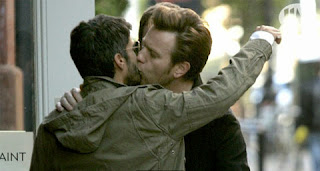
Ewan McGregor with his tongue inside a man's mouth. Just a friendly kIsS


Ewan McGregor was spotted greeting a man with a kiss yesterday in New York. A friendly kiss.

However, he's not opposed to the more intimate kind. The L.A. Times recently asked McGregor if he thinks America is ready for his prison romance film I Love You Phillip Morris.

Said McGregor: "It seemed to go down very well there at Sundance. It's a love story, an escape movie and a comedy, all about this man who goes to incredible lengths to be with the man he loves. I like it because it's a gay film, which is to say it's a film about two men in love, and I think that's an important element of it. But it's not a film about them being gay. They just happen to be gay. I also got to French kiss Jim Carrey a lot, and I quite like that too."

That film is due out in February.

SEARCH This BLOG

Loading...

Amazon SearchBox/ Most Things You buy through here will give us a few cents

Popular Posts

The Forest Needs help

ONE

ONE
Relief World Hunger

Save The Lungs of The Earth

Orangutans ARE Part of the Forest

Love is Sharing

Pride Shack

Gay Male Pride Items #1 (Vertical Banner)

Click Here To Get Anything by Amazon- That will keep US Going

Young Love Collection

CDC

SiGn ThE PeTiTiOn

DVD's

HIV Army

Blog Archive