November 16, 2009

Decapitated because he was gay in Puerto Rico


GAY PUERTO RICAN TEEN DECAPITATED, DISMEMBERED, AND BURNED


Over the weekend the brutalized body of gay teen George Steven Lopez Mercado was found by the side of a road in Puerto Rico. The police investigator suggested that he deserved what he got because of the "type of lifestyle" he was leading.

According to an iReport by Chrisopher Pagan: "On November 14 the body of a gay 19 year old was found a few miles away from the town in which he was residing in called Caguas. He was a very well known person in the gay community of Puerto Rico, and very loved. He was found on the site of an isolated road in the city of Cayey, he was partially burned, decapitated, and dismembered, both arms, both legs, and the torso. This has caused a huge reaction from the gay community here, but its a difficult situation. Never in the history of Puerto Rico has a murder been classified as a hate crime. Even though we have to follow federal mandates and laws, many of the laws in which are passed in the USA such as Obama’s new bill, do not always directly get practiced in Puerto Rico. The police agent that is handling this case said on a public televised statement that 'people who lead this type of lifestyle need to be aware that this will happen'. As If the boy murdered Jorge Steven Lopez was asking to get killed..."

Here's a report on the murder (in Spanish) from PrimeraHora.com. Said activist Pedro Julio Serrano: "It is inconceivable that the investigating officer suggests that the victim deserved his fate, like a woman deserves rape for wearing a short skirt. We demand condemnation of this investigator and demand that Superintendente Figueroa Sancha replace him with someone capable of investigating this case without prejudice." (my translation, please suggest a better one if you can).

POSTED 8:49 AM EST BY ANDY TOWLE IN CRIME, NEWS, PUERTO RICO | PERMALINK

November 12, 2009

He got his, I got mine...they were not able to touch my face, but they tried to destroy my car. No arrests, no action even though is classified as a"


ANOTHER HATE CRIME. I you don't know this person in Ontario, but you know me...then you know somebody who was given the same verbal diatribe and then violence!

ONTARIO MAN JUMPS FROM MOVING TRUCK TO ESCAPE GAY BASHER


Another gay bashing in Ontario, Canada, this one in the city of London, happened less than a week after Jake Raynard was beaten by a gang in Thunder Bay.

Xtra reports:

"Brandon Wright, an event manager and modelling agent, says a man who called himself Alex approached him online via instant messenger. The man told Wright he was an aspiring model looking for work. Wright arranged to meet Alex near a variety store on Kipps Ln near Adelaide St in London. After meeting, Wright told the man that he wouldn’t be able to help him find a modelling job. 'He just didn’t have the looks for it,' says Wright. The man then told Wright that he wanted to show him something in his truck. When Wright climbed into the passenger side he says the man said, 'Because you’re gay you need to be punished. I’m going to fucking kill you and you’re a faggot.' The man then drove off with Wright still in the passenger seat. 'He started hitting me with a big, black, heavy object,' says Wright. 'He kept repeating, 'I’m going to fucking kill you faggot.'' Wright says the attack continued even while the man was driving. Wright jumped out of the moving truck to escape."

Wright says he was helped by bystanders. Police say they have a lead on the subject, who reportedly said he was from Thunder Bay.

Guess what...we are all human..straight couples vs gay couples

Study Shows Similarities Between Same- and Opposite-Sex Couples
November 5, 2009 5:07PM
Michael Cole
This post from HRC Family Project Director Ellen Kahn reflects on the new study showing similarities between same- and opposite-sex couples:
As a teenager, I never imagined my life would resemble that of my parents. No, as a “baby dyke,” marriage was out of the question, and kids… well I certainly did not think gay people ever had chidren. The idyllic life of a house with a picket fence was for other people, not me. And back then, I was perfectly content knowing that my life would indeed be “non-traditional” as long as it meant I could be myself.
My partner, however, recalls a different experience in her early adulthood. Her parents were very happily married (ultimately for 45 years) and she wanted a relationship like theirs, and she wanted to raise children. For her, coming out as a young adult was liberating, but she was deeply saddened to know that she may lose the chance to have what he parents had. For both of us, and for thousands of others who came out in “our generation,” 30 years ago, it was not easy to imagine that we would marry our true love, have children, and blend into a neighborhood of other “straight” couples doing the same thing. Marriage wasn’t for us — raising children wasn’t for us, it was for someone else. And whether we wanted to let go of our own dreams of that seemingly idylllic life or not, it was easier on the psyche to do so.
Fast forward to this moment. Earlier this week, a report released by the Williams Institute shows us a completely different reality, and a very hopeful one for the young people who are coming out now. We can and do “couple” like our parents. We can and do have children, and we see ourselves as “just as married” as other couples even when the laws of our state or jurisdiction do not legally recognize us. You might say that we have changed the definition of marriage simply by claiming it for ourselves and not just sitting back to wait for the “powers that be” to tell us we are married. As someone once said, “if it looks like a duck, and walks like a duck, it’s a duck.” If we commit ourselves to another person and establish a household together, if we are raising children together or choosing not to, and if we are caring for one another and supporting one another through the joys and challenges of life, we are married. It’s that simple.
For me it is heartening to know that couples everywhere, and particulary in some unfriendly territory have made marriage theirs. After all, marriage — or whatever you might prefer to call the experience of being in a long-term committed relationship and sharing a household together — is a lifestyle, or a way of life that many of us want, and we should indeed make it ours.
Clearly not everyone has caught up to us. Tuesday’s outcome in Maine is a real and painful example of that. So while we continue to live our lives openly and strive toward the idyllic life we want for ourselves and our families, the hard truth is that we are not really “just like them.” We are not just like our parents or like John and Mary next door. Because it is still a very radical and threatening notion that two women or two men can “have what they have.” It’s not easy, and sometimes not safe, to hold my partner’s hand in public. It’s often anxiety-producing when we take our children to a new doctor or to meet the parents of a new friend. So while we know in our hearts that our relationships and our families are just as “real” as others, we are still facing legal and social obstacles. We are a brave and determined people, as evidenced by the findings in the report. Let’s continue to name our “spouses, husbands, wives and partners.”
Overall, the recent Census data has given a clearer picture of the diversity and broad geographic distribution of the LGBT community. For instance, one in six same-sex couples live in rural areas and one in four same-sex couples are non-white. It’s imperative that we continue telling our stories and part of that is standing up to be counted in the census. Learn more about the ”Our Families Count” project, a public education campaign (of which The Williams Institute and HRC are both a part) to encourage LGBT people to participate in the 2010 U.S. Census.

November 10, 2009

House Version of Health Bill is Gay inclusive

On Nov. 7, The House of Representatives approved a health care reform bill that would correct many of the problems that afflict health care in America. That bill, now headed for the Senate, contains provisions that would rectify inequities and extend better medical care to GLBT Americans and their families.

The House version included several items that had been lobbied for by GLBT equality advocates, including a change in tax laws that penalize gay and lesbian families who receive partnership benefits through their employers. As reported in the New York Times, the 1996 "Defense of Marriage" Act (DOMA) specifies that same-sex families cannot be recognized under federal law.

Thus, the value of such health benefit packages is taxed as income. This effectively has added an additional financial burden to gay and lesbian families that their heterosexual counterparts do not face.

The article quoted the member of the House who had introduced language to correct the situation, Washington Rep. Jim McDermott, a Democrat. McDermott said that the provision would "correct a longstanding injustice, end a blatant inequity in the tax code and help make health care coverage more affordable for more Americans."

"I meet people all the time who are gratified they work for companies that offer domestic partner benefits," Joe Solmonese, president of the Human Rights Campaign, told the Times. "But they pass on the benefits because they cannot afford the taxes that go with the benefits."

The HRC’s website detailed several legislative provisions included in the bill for which the equality organization had lobbied for years. Among those provisions is language that denotes GLBTs as a "health disparities population" and provides research funds to look into the ways in which sexual orientation and gender identity impact access to health care.

Also, there is a provision in the House version to provide early Medicaid support for mediations to treat HIV early, rather than waiting for the virus to lead to AIDS, in which patients’ immune systems have been so badly ravaged that they are susceptible to infections and opportunistic disease. Early treatment has been shown to be crucial in keeping people living with HIV healthier and able to survive for considerably longer periods of time than when treatment is delayed.

The bill also contains provisions for comprehensive sex education that would teach abstinence but also provide accurate information about how to prevent STD transmission, including HIV.

The issue of medical discrimination against GLBTs is also covered, in a provision that requires health providers to care for GLBT patients with the same level of professionalism and dedication that is shown toward heterosexual patients.

Whether those provisions will be part of any final bill that is sent to President Obama for signing remains to be seen. GOP Senate leaders have denounced the current version of the bill.

South Carolina Republican Sen. Lindsey Graham pronounced the bill "dead on arrival," while independent Sen. Joe Lieberman said that he could not endorse the House version of the bill "as a matter of conscience," the Associated Press reported.

House Version of Health Bill is Gay Inclusive
by Kilian Melloy
Monday Nov 9, 2009

November 8, 2009

My Gaydar also goes off..But then we know that some closeted gays have been the ones that persecute us.

FRIDAY, NOVEMBER 6, 2009

Dan Savage: "President Obama is a fierce advocate of gay rights the same way I'm a ladies' man. He isn't, and I'm not."
Posted by John Aravosis (DC) at 1:29 PM
Wow. Dan went on Olbermann last night, and was absolutely amazing. Interestingly, the first part of the segment shows Marc Mutty, the chairman of the anti-gay forces in Maine, who also works for the Catholic church up there. Had I met Mutty as a stranger on the street, I'd have been absolutely positively convinced that he was gay. I'm not saying Mutty is gay at all - I have no idea what his sexual orientation is. I just find it queer that so many of these anti-gay activists, like Mutty and Tony Perkins at the Family Research Council, among others, set off my gaydar to such an extent. It's just interesting.
gayamericablog

November 5, 2009

The banks took the $ and the economy, now they take the vaccine first.

Amid shortage, big NYC firms get swine vaccine
Rules allow company docs to request vaccine, distribute to high-risk groups

NEW YORK - Some of New York City's largest employers — including Wall Street firms like Goldman Sachs and big universities — have started receiving doses of the much-in-demand swine flu vaccine for their at-risk employees.

The government-funded vaccine is being distributed to states, where health departments decide where to send the limited doses. In New York, health officials are allowing businesses with onsite medical staff to apply for the vaccine.

Doctors for large companies can ask for the vaccine along with other doctors but must agree to vaccinate only high-risk employees like pregnant women and those with chronic illnesses, said Jessica Scaperotti, a spokeswoman for New York City's Department of Health and Mental Hygiene.

Last month, the city began offering vaccine to schoolchildren, as well as pediatricians and obstetricians who asked for it. Scaperotti said only half of the pediatricians in New York City have requested vaccine

"As the vaccine became more available we expanded it to adult providers," Scaperotti said. She called the large employers "a great avenue for vaccinating people at risk."

But a critic said Wall Street firms shouldn't have access to the vaccine before less wealthy Americans.

"Wall Street banks have already taken so much from us. They've taken trillions of our tax dollars. They've taken away people's homes who are struggling to pay the bills," union official John VanDeventer wrote on the Service Employees International Union Web site. "But they should not be allowed to take away our health and well-being."

The union has about 2 million members, including health care workers.

Vaccine in short supply
The swine flu vaccine has been in short supply nationwide because of manufacturing delays, resulting in long lines at clinics and patients being turned away at doctor's offices. The vaccine started trickling out in early October, and there are now nearly 36 million doses available.

The Centers for Disease Control and Prevention does not review and sign off on the decisions of state and city health departments as to which doctor's offices and businesses will be sent vaccine doses, said spokesman Tom Skinner.

The CDC director, Dr. Thomas Frieden, however, did send a letter Thursday to state and local health departments asking them to review their distribution plans and make sure the vaccine is getting to high-risk groups. Frieden said any decisions that appear to direct vaccine outside priority groups "have the potential to undermine the credibility of the program."

The agency has set guidelines on which patients should be at the front of the line: children and young people through age 24, people caring for infants under 6 months, pregnant women, health care workers and adults with health conditions such as asthma and diabetes.

Swine flu — which scientists call the 2009 H1N1 strain — is widespread throughout the country now, much earlier than seasonal flu usually hits.

Goldman Sachs has received 200 doses and Citigroup has received 1,200, health officials said. So far, 800,000 doses have been delivered to 1,400 health care providers in New York City, including public schools, pediatricians and hospitals.

In statements, Citigroup and Goldman Sachs said the vaccine would only go to those in high-risk groups.

"Goldman Sachs, like other responsible employers, has requested vaccine and will supply it only to employees who qualify," said spokesman Ed Canaday.

Morgan Stanley received 1,000 doses of the vaccine for its New York and suburban offices, but turned over its entire supply to local hospitals when it learned it received shipments before some area hospitals, spokeswoman Jeanmarie McFadden said.

Some New York pediatricians' offices that have gotten vaccine say the supply is not meeting the demand.

Manager Linda O'Hanlon at Uptown Pediatrics in Manhattan, said her office has received 500 doses so far — not enough for a practice with almost 7,000 patients.

"We have about 800 appointments" set up for patients who want to get vaccinated, she said.

October 28, 2009

A Hate crimes calls meF*** Fagget come out and see your car being destroyed

On Friday October 23 on the way to my car, I was assaulted in the private parking lot of my building. F***Fagget was what was repeated by one guy and his brother. Not tenants in my building, but they come and go freely somehow.
On Sunday October 25, I heard a diatribe of fucking fagget out of my window. These two guys were calling me to watch as they destroyed my car.
More to come when they get apprehended. Hate Crimes Task Force is investigating. Can say much more now.

October 24, 2009

How do you feel if you were follow to see if you picked up after your dog??

I picked up this story at the NYTimes. It made sense to publish it now that these days in which more and more police and private cameras cover our moves in this city; There are people asking for more, because of fear to crime and terror. On the other hand there many on the other side asking for their right to privacy. Where do you stand???????????AG

Constant Surveillance Rankles Britons

By SARAH LYALL
Published: October 24, 2009
POOLE, England — It has become commonplace to call Britain a “surveillance society,” a place where security cameras lurk at every corner, giant databases keep track of intimate personal details and the government has extraordinary powers to intrude into citizens’ lives.

Andrew Testa for The New York Times
Jenny Paton with her daughters Thea, left, and Esme last month at their home in Poole. A school application by a third and youngest daughter set off a local council's surveillance of the family.

A report in 2007 by the lobbying group Privacy International placed Britain in the bottom five countries for its record on privacy and surveillance, on a par with Singapore.

But the intrusions visited on Jenny Paton, a 40-year-old mother of three, were startling just the same.

Suspecting Ms. Paton of falsifying her address to get her daughter into the neighborhood school, local officials here began a covert surveillance operation. They obtained her telephone billing records. And for more than three weeks in 2008, an officer from the Poole education department secretly followed her, noting on a log the movements of the “female and three children” and the “target vehicle” (that would be Ms. Paton, her daughters and their car).

It turned out that Ms. Paton had broken no rules. Her daughter was admitted to the school. But she has not let the matter rest. Her case, now scheduled to be heard by a regulatory tribunal, has become emblematic of the struggle between personal privacy and the ever more powerful state here.

The Poole Borough Council, which governs the area of Dorset where Ms. Paton lives with her partner and their children, says it has done nothing wrong.

In a way, that is true: under a law enacted in 2000 to regulate surveillance powers, it is legal for localities to follow residents secretly. Local governments regularly use these surveillance powers — which they “self-authorize,” without oversight from judges or law enforcement officers — to investigate malfeasance like illegally dumping industrial waste, loan-sharking and falsely claiming welfare benefits.

But they also use them to investigate reports of noise pollution and people who do not clean up their dogs’ waste. Local governments use them to catch people who fail to recycle, people who put their trash out too early, people who sell fireworks without licenses, people whose dogs bark too loudly and people who illegally operate taxicabs.

“Does our privacy mean anything?” Ms. Paton said in an interview. “I haven’t had a drink for 20 years, but there is nothing that has brought me closer to drinking than this case.”

The law in question is known as the Regulation of Investigatory Powers Act, or RIPA, and it also gives 474 local governments and 318 agencies — including the Ambulance Service and the Charity Commission — powers once held by only a handful of law enforcement and security service organizations.

Under the law, the localities and agencies can film people with hidden cameras, trawl through communication traffic data like phone calls and Web site visits and enlist undercover “agents” to pose, for example, as teenagers who want to buy alcohol.

In a report this summer, Sir Christopher Rose, the chief surveillance commissioner, said that local governments conducted nearly 5,000 “directed surveillance missions” in the year ending in March and that other public authorities carried out roughly the same amount.

Local officials say that using covert surveillance is justified. The Poole Borough Council, for example, used it to detect and prosecute illegal fishing in Poole Harbor.

“RIPA is an essential tool for local authority enforcement which we make limited use of in cases where it is proportionate and there are no other means of gathering evidence,” Tim Martin, who is in charge of legal and democratic services for Poole, which is southwest of London, said in a statement.

The fuss over the law comes against a backdrop of widespread public worry about an increasingly intrusive state and the growing circulation of personal details in vast databases compiled by the government and private companies.

“Successive U.K. governments have gradually constructed one of the most extensive and technologically advanced surveillance systems in the world,” the House of Lords Constitution Committee said in a recent report. It continued: “The development of electronic surveillance and the collection and processing of personal information have become pervasive, routine and almost taken for granted.”

The Lords report pointed out that the government enacted the law in the first place to provide a framework for a series of scattershot rules on surveillance. The goal was also to make such regulations compatible with privacy rights set out in the European Convention on Human Rights.

RIPA is a complicated law that also regulates wiretapping and intrusive surveillance carried out by the security services. But faced with rumbles of public discontent about local governments’ behavior, the Home Office announced in the spring that it would review the legislation to make it clearer what localities should be allowed to do.

“The government has absolutely no interest in spying on law-abiding people going about their everyday lives,” Jacqui Smith, then home secretary, said.

One of the biggest criticisms of the law is that the targets of surveillance are usually unaware that they have been spied on.

Indeed, Ms. Paton learned what had happened only later, when officials summoned her to discuss her daughter’s school application. To her shock, they produced the covert surveillance report and the family’s telephone billing records.

Could this be what Gates said about a more humane in enforcing DADT?

Could ruling relax 'Don't Ask' without law change?
Source: DOD examining Witt as way to ease enforcement
By CHRIS JOHNSON | Oct 24 2009, 8:09 AM

The Defense Department is examining whether a ruling in a lawsuit challenging “Don’t Ask, Don’t Tell” could be used to relax enforcement of the policy without changing the law, according to a Senate aide.

The Pentagon “is looking carefully” at the 9th Circuit Court of Appeals ruling last year in Witt v. Air Force “to see if there are any nationwide implications beyond the Ninth Circuit,” said the aide, who spoke to the Washington Blade on condition of anonymity.

The ruling challenged the U.S. military to prove that the presence of Maj. Margaret Witt, a lesbian nurse who was discharged under “Don’t Ask, Don’t Tell” after serving in the Air Force for 18 years, was detrimental to unit cohesion.

The 9th Circuit remanded the case to district court for further consideration last year in light of protections granted by the U.S. Supreme Court’s 2003 ruling in Lawrence v. Texas.

“It does not appear that there are” nationwide implications to the ruling, the aide said. “However, given the higher standard that applies for the 9th Circuit, [it] could be relevant across the country.”

The aide continued: “Given the fact that [Defense] Secretary [Robert] Gates has publicly said we’re going to look for humane ways to do this, clearly, the higher standard established in the Ninth Circuit provides some guidance on how to do that.”

Doug NeJaime, a gay associate professor at Loyola Law School, Los Angeles, said the Witt case “could be a way to keep ‘Don’t Ask, Don’t Tell’ on the books, but enforce it in a way that actually effects a much less significant number of people.”

NeJaime said Witt is an as-applied challenge, meaning the 9th Circuit considered “Don’t Ask, Don’t Tell” as a way to further government interests to maintain unit cohesion.

But the 9th Circuit disputed that notion in its ruling, and said in a footnote that it’s not Witt’s sexual orientation that undermines unit cohesion, but the process of discharging her from her unit.

NeJaime said if the U.S. military used this standard in its enforcement of “Don’t Ask, Don’t Tell,” the law could be applied “in a more case-by-case” basis and examine whether the discharge of each service member actually inhibited unit cohesion.

“So, if [discharging] actually undermines unit cohesion … then you wouldn’t discharge,” NeJaime said. “So, I mean, it could allow for a much more forgiving ‘Don’t Ask, Don’t Tell’ policy.”

This application of “Don’t Ask, Don’t Tell” seems to be consistent with remarks Gates made in June, when he said he’s looking for a “more humane” way to implement the law, as well as whether there is any “flexibility” in applying it.

"Let me give you an example,” he said at the time. “Do we need to be driven when the information, to take action on somebody, if we get that information from somebody who may have vengeance in mind or blackmail or somebody who has been jilted?"

Cynthia Smith, a Pentagon spokesperson, didn’t respond to a request for comment on whether the Defense Department was looking at the Witt case as a way to mitigate “Don’t Ask, Don’t Tell.”

But in an earlier e-mail, Smith confirmed that officials were consulting with legal experts to find a different way to apply the law.

“The Secretary has asked the DOD General Counsel to review the law to determine if there is any flexibility in how this law is applied,” she said. “This action is still currently being reviewed by the [Office of the General Counsel.]”

Smith said there was no set time for a conclusion of this review.

Kevin Nix, spokesperson for the Servicemembers Legal Defense Network, also said the Pentagon could decide to follow the Witt standard as a way to change application of “Don’t Ask, Don’t Tell” for the entire military, even though the ruling is technically only binding in the 9th Circuit.

But Nix said SLDN doesn’t view a relaxation of “Don’t Ask, Don’t Tell” under Witt as a more humane application of the law.

“SLDN believes the [Don’t Ask, Don’t Tell’] law is unconstitutional and inherently inhumane,” he said. “There is no way to apply it to make it constitutional. Congress must repeal the law.”

Still, Nix identified a number of options for greater flexibility under “Don’t Ask, Don’t Tell” until Congress repeals the law.

The Defense Department, Nix said, can instruct services conducting investigations under the law to follow several guidelines, such as requiring the allegation of homosexuality to come from another service member and not a civilian or an anonymous tipster.

Nix also said the Pentagon could change application of the law so that hearsay couldn’t support an inquiry; only homosexual conduct after joining the armed forces would be eligible for investigation and statements made to chaplains, doctors, psychologists or other health professionals couldn’t be used as a basis for inquiry.

October 22, 2009

Men that voted for McCain were not able to get it up that night.

Republican men nationwide may have experienced a drop in testosterone levels the night Barack Obama was elected president, according to the results of a small study that found another link between testosterone and men's moods.


Low testosterone levels in men are linked to increased risk of premature death.
By taking multiple saliva samples from 183 young men and women on election night, researchers found that the testosterone levels of men who voted for John McCain or Robert Barr dropped sharply 40 minutes after Obama was announced the winner.

The testosterone levels of men who voted for Obama stayed the same throughout the evening. This could be significant because testosterone levels normally rise and fall throughout the day.

The study, published in in PLOS One, is one of many that indicates a link between men's moods and testosterone, although which causes which is not clear.

Women who voted for a losing candidate did not show a similar drop in testosterone, although in a questionnaire prepared by the researchers they reported feelings of unhappiness, of being controlled and feeling submissive similar to those remarked by men who voted for a losing candidate.

Clossetted Gay Gov. Charlie Christ sells his soul to the Unchristian right!

Crist to Headline Christian Fund-raiser

Florida governor Charlie Crist, a frequent subject of gay rumors, will headline a right-wing Christian fund-raiser next month as he seeks to outmaneuver Marco Rubio, his more conservative opponent for the U.S. Senate nomination in 2010.

According to the St. Petersburg Times,Crist will address an audience that supported Amendment 2, which last year wrote a ban on same-sex marriage and equivalent unions into Florida's constitution.

“Crist will headline the Christian Family Coalition's annual gala on Nov. 13 in Miami,” the Times reported. “The group opposed Miami Dade's registry of same-sex partners and advocated the constitutional amendment banning gay marriage.”

The flirtation with the religious right represents a change in tone for Crist, previously described as more of a moderate, according to the Times.

“Crist's appointments of Ricky L. Polston and Charles Canady to the Florida Supreme Court last year were both heavily backed by the religious right," the paper reported. "But he campaigned in 2006 as a moderate who didn't crusade against abortion, gay civil unions or embryonic stem cell research.
By Julie Bolcer

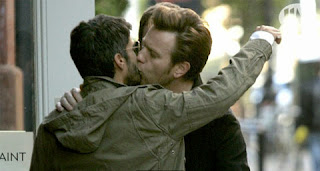
Ewan McGregor with his tongue inside a man's mouth. Just a friendly kIsS


Ewan McGregor was spotted greeting a man with a kiss yesterday in New York. A friendly kiss.

However, he's not opposed to the more intimate kind. The L.A. Times recently asked McGregor if he thinks America is ready for his prison romance film I Love You Phillip Morris.

Said McGregor: "It seemed to go down very well there at Sundance. It's a love story, an escape movie and a comedy, all about this man who goes to incredible lengths to be with the man he loves. I like it because it's a gay film, which is to say it's a film about two men in love, and I think that's an important element of it. But it's not a film about them being gay. They just happen to be gay. I also got to French kiss Jim Carrey a lot, and I quite like that too."

That film is due out in February.

October 20, 2009

Mob hit man out of the closet: Robert Mormando is gay

Mob hit man out of the closet: Robert Mormando is gay and regrets life of crime, his lawyer says

BY JOHN MARZULLI
DAILY NEWS STAFF WRITER

Tuesday, October 20th 2009, 4:00 AM

RELATED NEWS
ARTICLES
Mob rats describe other side of Junior Gotti
Junior Gotti's defense considering putting turncoat Sammy Gravano on stand
Intimidating jurors was the Gotti way, tapes reveal in Junior Gotti trial
Boo-hoo for the mob boss: Prison food is too starchy, he says
Mafia turncoat testifies he made payoffs to Junior Gotti
Juror released from Gotti trial amid fears over near-accident wasn't accident
Mob hit man Robert Mormando stunned a veteran Brooklyn judge Monday when he renounced his membership in La Cosa Nostra and - for good measure - acknowledged he was gay.

"That's the first time I've heard this in court," Federal Judge Jack Weinstein said of the mobster's renunciation of his blood oath.

"I've asked many Mafia members and they've always refused," added Weinstein who was appointed to the bench in 1967 by President Lyndon Johnson.

Mormando, 44, a divorced father of two sons, was being sentenced for participating in the shooting of Queens bagel store owner Angelo Mugnolo, who was wounded in the driveway of his Howard Beach home in 2003

The rubout was ordered by Vincent Gotti, the younger brother of late crime boss John Gotti, who suspected the baker was fooling around with his wife.

Mormando became a government informant shortly after the shooting. He did not have have to testify against accomplices Vincent Gotti, his nephew Richard Gotti and Angelo Ruggiero Jr., because they pleaded guilty to murder conspiracy charges last year.

Sources said Mormando's cooperation was kept a closely guarded secret until he came out Monday.

The court calendar did not identify him by name and he was referred to as "John Doe" throughout the proceeding.

Defense lawyer Nancy Ennis told the judge Mormando was given the contract a month after he was inducted into the crime family in 2002.

"He was summoned to perform an act that he found totally unacceptable afterward," Ennis said.

"He did follow through, but he found the incident to be so disagreeable shortly after that he started having strong thoughts about leaving the mob.

"He was living in hiding, not from law enforcement, but from La Cosa Nostra."

Ennis' biggest bombshell was announcing that Mormando is out of the closet.

"He has been openly gay since he left the mob," Ennis said.

Mormando's partner has refused to enter the witness protection program, but they have relocated and together they "live a peaceful working life," she said.

Members of the Mafia do not accept a gay lifestyle within its ranks although there is no specific rule that inductees must accept, like the prohibition from having an affair with another gangster's wife.

Former DeCavalcante crime boss John D'Amato was whacked in 1992 for being gay.

A burly gay hit man named Vito Arena was a member of the murderous Roy DeMeo crew. He, too, became a mob informant, but he returned to a life of a crime and was shot dead in a botched armed robbery.

In any event, Weinstein was more interested in asking Mormando what attracted him to the mob.

"As a young kid growing up in Ozone Park, John Gotti was a hero," Mormando explained. "He had cars. Power. I regret that now."

Weinstein asked: "Are you publicly willing to resign that organization?"

"Yes your honor, I already have," Mormando said.

The former wiseguy was sentenced to time served - which was no time at all. He faced up to 17 years in prison.

jmarzulli@nydailynews.com

October 19, 2009

What's the Proper Punishment for the Parents of 'Balloon Boy'?

SHARE: You know the sick, panicked fear that your child may be in danger? I'm not sure the parents of "balloon boy'' do.

They claimed their 6-year-old was stuck on a hot-air balloon floating across Colorado last week. But the only physical danger he was ever in? The risk of being stampeded by cameramen waved in by his shameless father -- a storm-chaser so high on the crack of national attention that after his 15 minutes on the show "Wife Swap" elapsed, he pretended his son had been carried away like the Wizard of Oz. (Apparently, the stunt was intended to help the dad close the deal on a reality show pitch that would have presented him as a mad scientist. At least that part is believable.)

On Sunday, the sheriff who had been defending the couple – because who would pretend their kid might have died just to get a little drama going? -- said he'd concluded that the whole thing was a publicity stunt. Criminal charges, he said, may include conspiracy and contributing to the delinquency of a minor. But what kind of punishment would fit this particular crime?

Given that local law enforcement already wasted an ocean of adrenaline on these people, and spent big bucks on a rescue effort that ruined a local farmer's wheat crop and shut down Denver International Airport for several hours, I'm not so sure about throwing away more money on prosecution or incarceration. One story mentioned a fine of as much as $500,000; good luck collecting that.

After all they've been through with this family, I give the authorities huge credit for encouraging the child's mom to get out of the situation, though she's turned them down, at least for now. And maybe the worst of it is that it's hard to think of a penalty for the parent that wouldn't further traumatize the child, who has presumably already been sentenced to another dozen years or so with his lunatic father, who will go unnamed here: Take that, oh Munchausen by proxy syndrome sufferer of the reality TV age.

Judge refuses to dismiss gay marriage ban suit He asks lawyers to show how gay unions pose threat to traditional ones

SAN FRANCISCO - A federal judge challenged the backers of California's voter-enacted ban on same-sex marriage Wednesday to explain how allowing gay couples to wed threatens conventional unions, a demand that prompted their lawyer to acknowledge he did not know.

The unusual exchange between U.S. District Chief Judge Vaughn Walker and Charles Cooper, a lawyer for the group that sponsored Proposition 8, came during a hearing on a lawsuit challenging the measure as discriminatory under the U.S. Constitution.

Cooper had asked Walker to throw out the suit or make it more difficult for those civil rightsclaims to prevail.

The judge not only refused but signaled that when the case goes to trial in January, he expects Cooper and his legal team to present evidence showing that male-female marriages would be undermined if same-sex marriages were legal.

‘Naturally procreative relationships’
The question is relevant to the assertion that Proposition 8 is constitutionally valid because it furthers the states goal of fostering "naturally procreative relationships," Walker explained.

"What is the harm to the procreation purpose you outlined of allowing same-sex couples to get married?" Walker asked.

"My answer is, I don't know. I don't know," Cooper answered.

Moment later, after assuring the judge his response did not mean Proposition 8 was doomed to be struck down, Cooper tried to clarify his position. The relevant question was not whether there is proof that same-sex unions jeopardize marriages between men and women, but whether "the state is entitled, when dealing with radical proposals to make changes to bedrock institutions such as this ... to take a wait and see attitude," he said.

"There are things we can't know, that's my point," Cooper said. "The people of California are entitled to step back and let the experiment unfold in Massachusetts and other places, to see whether our concerns about the health of marital unions have either been confirmed or perhaps they have been completely assuaged."

Walker pressed on, asking again for specific "adverse consequences" that could follow expanding marriage to include same-sex couples. Cooper cited a study from the Netherlands, where gay marriage is legal, showing that straight couples were increasingly opting to become domestic partners instead of getting married.

"Has that been harmful to children in the Netherlands? What is the adverse effect?" Walker asked.

‘Proof of no harm?’
Cooper said he did not have the facts at hand.

"But it is not self-evident that there is no chance of any harm, and the people of California are entitled not to take the risk," he said.

"Since when do Constitutional rights rest on the proof of no harm?" Walker parried, adding the First Amendment right to free speech protects activities that many find offensive, "but we tolerate those in a free society."

Walker made clear that he wants to examine other issues that are part of the political rhetoric surrounding same-sex marriage but rarely surface in courtrooms. Among the questions he plans to entertain at the trial are whether sexual orientation is a fixed or immutable characteristic, whether gays are a politically powerful group, and if same-sex marriage bans such as Proposition 8 were motivated by anti-gay bias.

The lawsuit over which Walker is presiding was brought by two unmarried same-sex couples. They have since been joined by lawyers for the city of San Francisco.

Attorney General Jerry Brown, who was named as a defendant, has taken the rare step of agreeing with the plaintiffs instead of arguing to uphold the voter-approved law.

In allowing the case to move forward, Walker said significant questions remain about whether the California measure, which was approved by 52 percent of voters in November, unlawfully violates the rights of gays and lesbians to equality and due process guaranteed under the U.S. Constitution. The measure overturned a state Supreme Court ruling earlier in the year that legalized same-sex marriages
(msnbc)

Twitter: Don't change your log-in data until further notice

by Juan Carlos Perez, IDG News Service

Twitter users should refrain from changing their log-in data until further notice or else risk getting locked out of their accounts.


Until the problem is resolved, Twitter users shouldn’t modify their log-in data, according to an official posting on Twitter’s Status Web site.

“This seems to affect new users as well as long term users,” the note reads.

Users first started reporting the problem late last week, according to messages posted on the site’s Known Issues section.

Twitter has made the fixing of this problem a top priority, and at the moment believes the cause might be a caching bug somewhere in its systems, according to information on the Known Issues page.

This is the latest technical hiccup that has affected Twitter in recent days. On Monday, the company acknowledged that the site experienced increased system errors and that users had trouble authoring and posting messages. The latter issue apparently remains outstanding. Last week, a bug caused a delay of several hours in updates to users’ message streams.

Twitter, a social network and microblogging site, has become tremendously popular among individuals and organizations since its launch in March 2006, but along the way has earned a reputation for having wobbly performance and uptime.

Twitter experienced lengthy and frequent system outages in 2007 and during the first half of 2008, but since then the situation has improved.

Twitter ended 2008 with 84 hours of downtime, which gave it an uptime frequency of 99.04 percent, the worst among 15 major social-networking services reviewed by Web monitoring company Pingdom.

At Twitter, individuals provide real-time updates about themselves, while organizations use it as a marketing tool. Twitter messages can’t be longer than 140 characters.

Why does Face Book needs to know??

Be aware that quizzes are revealing
For many users, one of the primary attractions of Facebook is the virtually endless selection of games and quizzes. Part of the lure of the games and quizzes is the social aspect. In the games, friends can compete against one another; through the quizzes, you can learn more about your friends while being briefly entertained.

The ACLU exposed problems with how much information these quizzes and games share, though. When a Facebook user initiates a game or quiz, typically a notice pops up to declare that interacting with the application requires opening access to information; the notice also provides the user the opportunity to opt out and cancel, or to allow the access to continue.

The permission page clearly tells the user up front that allowing “access will let [the application] pull your profile information, photos, your friends’ info, and other content that it requires to work.” One might wonder, as the ACLU has, why any game or quiz application would “require” access to your friends’ information in order to work.

IRISH HURLER DONAL OG CUSACK: 'I'M GAY'


I

Donal Og Cusack, a legendary Irish goalkeeper in the Gaelic sport of hurling, has come out of the closet in a new biography, the Belfast Telegraph reports:

"The player has lifted the lid off his bisexual past in a candid story of his life that makes him the first ever senior GAA star to publicly declare his homosexuality. The Cork hurler from the small village of Cloyne is a legend in GAA circles after winning three All-Ireland finals. Yet in what may shock the sporting establishment, he admits to sleeping with both women and men before accepting his sexuality as a gay man in his autobiography Come What May published by Penguin Ireland and due out this month. In an honest and down-to-earth account of his life as one of the GAA's most high-profile players, he reveals how he tried to date women as a young man even though he knew from the age of 13 or 14 'that I was a bit different'. 'I tried to go out with women to make sure, to see what kind of feeling it gave me,' he writes.' I went out with nice women and good women, but sure, I still knew. I wanted something else. I get more out of men. I just do. Always have. I know I am different but just in this way. Whatever you may feel about me or who I am, I've always been at peace with it,' he said

Two Democratic Senators Refuse to Support DOMA repeal

The message from Democrats (including openly gay Rep. Barney Frank) is that the 111th Congress will pass trans-inclusive hate crimes and employment non-discrimination legislation, will pass domestic partner benefits for federal employees, and will repeal Don't Ask Don't Tell. All this if we're lucky.

Noticeably absent from this civil rights agenda is the repeal of the Defense of Marriage Act. Apparently a Democratic majority in the House, a Democratic super-majority in the Senate, and a Democratic president in the White House isn't quite enough to get a repeal passed. Of course, other major issues are confronting the nation, and issues dealing with same-sex marriage often bring with them volatile politics. But, with the prospect of trimmed Democratic majorities in Congress after the 2010 midterm elections, is it really unreasonable for the LGBT community to expect action on DOMA now, as opposed to potentially a decade from now, maybe later?

The national mood seems favorable to a DOMA repeal. A majority of Americans support civil unions for same-sex couples and a DOMA repeal deals primarily with granting civil rights to already-married same-sex couples, not with creating new marriage designations. And with same-sex marriage sweeping New England and even becoming legal in Iowa, the momentum and the need for federal rights for married same-sex couples has never been greater. This is especially true as Washington, DC, New York, and New Jersey seem poised to legalize same-sex marriage before year's end.

President Obama has spoken of his commitment to repeal DOMA, but he has not given any timelines for how or when this will happen. In Congress, a DOMA repeal was introduced in the House in mid-September with many, including Rep. Frank, expressing skepticism that Congress had the votes to pass it. The repeal bill does have the support of the two other openly gay members of Congress, Rep. Tammy Baldwin and Rep. Jared Polis - both are signed on as cosponsors.

Whether or not a DOMA repeal passes in this legislative session (i.e. before the 2010 midterm elections) is going to be up to the LGBT community and its allies and the pressure they are able to exert on President Obama and Congress. The House bill to repeal DOMA has 101 cosponsors to date (Rep. Jerrold Nadler introduced the bill). The rest of the Democrats in the House are silent on the issue. No bill has been introduced in the Senate and this is the pathetic support we get from Democrats there...
by: Dable post

A Dick is not enough to get you Laid By A Gay Man

A Dick Is Not Enough To Get You Laid By A Gay Man
*****************************************************
I'm a little late to this one but I could not leave it alone. Last week on Mad Man, Salvatore was fired because he refused to sleep with Lee Gardner Jr., the son of the owner of lucky strikes. Salvatore is married and is very deeply in the closet. Considering that Mad Men takes place in the 1960’s, it is fair to say that this was a fairly common occurrence for that period. Don seemed to imply that Salvatore should heave considered the large account and just slept with Lee. After all, the man has a dick and isn’t that all gay men want? He even had the nerve to refer to Sal as “you people”. Though this show is set in the 60’s, this attitude is still alive and well today. The construction of all gay men as solely seeking sex and not a loving connection with another human being, is just one of the ways in which they are constructed as “other.” Even though many are engaged in the struggle for same sex marriage, the construction of the promiscuous gay man is alive and well.

Balloon boys rap anti gay slurs

Balloon Boy, Brothers Rap Antigay Slurs

By Advocate.com Editors

The news just keeps getting worse for the Heene family, better known now to the world as the family behind the balloon scandal.

On the heels of news the Heene parents will face charges for what has now been deemed a “hoax” –- the Denver sheriff’s department says the Heenes “manipulated authorities and media into believing their son had flown away in a balloon (he was later found hiding in the attic) -- comes this video, shot just after the Heenes appeared on Wife Swap.

In the video, the Heene boys rap about the "pussification" of men and frequently use the word “faggot.” At about the 2 minute and 50 second mark, one of the boys talks about throwing a rock at a “faggot” in a tree.

October 18, 2009

For the first time some one has written my feelings without meeting me. Why Im no longer a Christian

Why should you care in the slightest about my religious views?

I cannot possibly imagine.

Several people on topix, though, in the wake of various postings I’ve made on religious subjects, have asked me for an explanation of just how I arrived at my present agnosticism, or atheism, or whatever it is. So rather than answering these various people individually I’ve elected to start this forum and direct the interested parties here.

What follows is nothing more or less than a summary of my personal experiences as a Christian, related about as honestly as I know how to do it. I’m not hoping for contributions, followers, or enlightenment, and I don’t claim it to be momentous or universal or significant to anyone but me. But it is genuine.

Dearth of Couth

Why I’m no longer a Christian, Part One

I was raised from my infancy by deeply religious people, surrounded by a family full of Baptist preachers, deacons and missionaries. I myself was baptized, as well as I can recall, at about the age of ten.

I can remember being struck by the fact that everyone around me at the time – and I do mean everyone – kept telling me that what I had just experienced was the most important event of my life, and that everything else I would ever do would shrink to insignificance alongside it. I was receiving the power of the Lord. It was a special time for me.

Well, I enjoyed all the attention, as any kid would, but I remember wondering: Why don’t I feel any different, myself? I thought about my attitudes, my perceptions, the circumstances of my life, and I couldn’t think of a single thing that was any different, now that I was one with Jesus. No matter how hard I tried to find something new and meaningful, there was nothing. It was a hollow, empty, and lonely sensation, and surprisingly so. It was not what I had expected at all.

I concluded after a time that I must not be doing something right. Everyone around me seemed so confident and secure in their faith and mine so tenuous in comparison, I felt left out. The shortcoming, I decided, must be mine. I must be missing something.

I resolved to try harder. I devoted myself to Bible study and prayer. I sensed that everyone around me would be horrified if I were to express any of these reservations I was feeling, so I kept them to myself. I suppressed them, and did my best to forget them altogether.

The years went by and I attended services regularly but somehow I never quite shook the uneasy sense, in the back of my mind, that I had never truly felt the presence of a transcendent being – Jesus, God, or anyone at all.

I remained outwardly compliant, but inwardly I began to feel isolated and as much as I tried to banish this feeling, it persisted. As I reached adulthood it intensified until I became aware that, despite my best efforts, it was not going to go way. More troubling still was the bulk of doubts I began to feel about matters of doctrine. I began to doubt, among many other things, the true value of grace.

But I tried to put these issues out of my mind. What I was doing, of course, was not avoiding a crisis but merely postponing it When it finally arrived it hit so suddenly, it startled me.
DearthOfCouth
“What do I know?”

Why I’m no longer a Christian, Part Two

I mentioned my doubts about the value of grace. Let me try to explain:

I learned early on that I, as a rather perceptive and articulate kid, wielded the power of language. I was able to wound someone deeply with a well-timed and chosen, derisive remark. I’m ashamed to say that I flung these about, at an early stage of my life, freely and easily. These thoughtless barbs of mine were the cause of a lot of needless pain. I believe they were the greatest sins of my commission, ever.

I was assured that my sins were forgiven me but I became aware after a time that the targets of my derision, once hurt or offended, remained hurt or offended for a very long time. Jesus’ forgiveness of me, I noted, made no difference at all to the people I had hurt. Things changed for me as I approached adulthood and began to feel genuine empathy for other people. In time I came to feel an element of real remorse for the thoughtlessness of my adolescence, and when I felt these regrets – I still feel them today -- I realized that Jesus’ grace made no real difference to me, either.

Grace was like the presence of God; everyone said it was real. But no matter how I tried, I was not able to feel it myself.

My crisis arrived one day at a church prayer service when the minister asked us all to recall our thoughts and feelings on the day we were saved. Surely we remembered the day vividly. It was the most important day of our lives.

People around me began standing, one at a time, and giving witness. The recurring phrase, as I recall it, was “the weight of mountains off my shoulders.” I sat there in my pew and reflected in private silence over the vague, unfulfilled void I had experienced in the wake of my own baptism, by this time some ten years in the past.

The minister went on to inform us that we, as the committed Christians we were, ought still to enjoy that same exultant, liberated feeling today. Didn’t we?

Again the witnessing from the pews around me, everyone standing in turn to give solemn testimony that they did indeed feel the power of Jesus in their lives, each and every day. It was profound, they said. It was moving. They were touched, one and all, to the very core of their existence and the strength of their inspiration did not dissipate as time elapsed, but rather grew stronger.

It went on this way. I turned this way and that to listen as the faithful on all sides of me rose and gave vivid testimony. The passion of Jesus, apparently, was with everyone in the assembly. Except me.
DearthOfCouth
“What do I know?”


Why I’m no longer a Christian, Part Three

Then it hit me: We were moving around the congregation as if someone were taking role, and we were not leaving anyone out. More and more of them had begun to turn their attention toward me, wide-eyed and expectant. Any minute now it was going to be my turn and I would be expected to offer my personal testimony. What was I going to say?

My options, it seemed to me, were as follows:

1. Come clean with everyone and confess my innermost doubts, to admit that I had searched diligently but in vain over the years for some evidence of an impact that Jesus had had upon my life. Or
2. Make something up. I could, I was certain, blather something about a luminous presence, something affecting every aspect of my life and making it better. In short, I could lie.
Lying seemed the easiest solution, and it tempted me. But it occurred to me – to whom would I be lying? Jesus? Am I honestly contemplating an attempt to con Jesus?

Then I thought, Who is it that I’ve been deceiving for the last ten years with this elaborate pretense, sitting here in this church? Who am I fooling? Jesus? God? My family? The congregation?

Myself?

The witnessing continued and the population of remaining, un-testified Christians was dwindling by the minute. I was going to have to reach a decision and very soon. I sensed that the choice I was about to make was going to influence the rest of my life, and I was at once relieved and energized to have reached a culmination and resentful that I was being compelled to reach it hurriedly, in a public forum.

My time was running out. What was I going to do?
DearthOfCouth
“What do I know?”


Why I’m no longer a Christian, Part Four

Finally, struggling with my private predicament in that pew during prayer service, I knew what it was that I had to do. I came to the realization that there was only one possible course of action that seemed to offer me any degree of self-respect, and there was no other course to take, so at long last I took it. I stood and walked out.

I did not look anyone in the eye as I passed and I have no idea whether anyone registered surprise, hostility, concern, or anything at all. For all I know they all faced forward and ignored me as I turned left at the end of the aisle and made my final exit from the building. The moment I reached the open air outside I was astonished to find that I was finally, after all this time, experiencing something that was vivid and genuine and undeniable. In fact it was nearly overpowering. It crested over me like a breaker:

Relief.

From now on, I resolved that day, I will not stop and examine my innermost thoughts and evaluate, whether they are appropriately reverent and sanctimonious. I will admit my doubts and reservations and when people ask me for my thoughts I will express them respectfully but openly, as I am doing now.

If everyone around me seems confident and secure where I am irresolute and sceptical then I decline to acknowledge this as a problem, for me or for anyone else. That’s just the way it is.

Leaving the prayer meeting that day was a liberating, exhilarating, and truly life-changing experience for me. It was my “baptism” and I will never forget it.

I’m free.

If I have to account someday for the decisions I’ve made and the actions I’ve taken, then I will. But I won’t again lie to anyone that I’m feeling something or sensing something when I’m not. I won’t try to deceive anyone around me but most importantly I won’t lie to myself. Life is too short to waste it that way.

iDoesn't

Verizon starts anti "iDevice" campaign, vows Palm Pre
updated 02:50 pm EDT, Sat October 17, 2009Verizon ad campaign to attack Apple

Verizon today sent signals that it's about to launch an aggressive campaign against Apple through a combination of marketing and devices. A leaked note regarding an upcoming ad series, nicknamed "iDoesn't," specifically targets the "iDevice" and will allegedly focus on all the features the iPhone doesn't have. The details Engadget sees are vague regarding the ads themselves but do mention that Verizon will keep branding to a minimum.
The first of the ads is due to play during the imminent Angels/Yankees baseball game, which begins at 8PM Eastern this evening, but should see heavy airplay during NFL games on Sunday and is likely to continue past that point. It promises that "big things" will come in November to take advantage of the campaign.

It's likely that the campaign is meant to steer customers towards a wave of major smartphone introductions at Verizon that will include the BlackBerry Storm2, the Android-based HTC Desire and the already publicized HTC Omnia II. All three are running smartphone platforms that have similar features to iPhones, but with multitasking and typically less restricted app catalogs. Verizon has stressed that its approach to Android won't overly limit apps and should allow Google Voice among other software Apple and AT&T have sometimes sought to ban on the iPhone.

Verizon has had a relatively poor history of marketing against Apple and on the iPhone's June 2007 launch day chiefly reiterated its variety of phones rather than any one "halo" device to lure users. The original BlackBerry Storm was also trumpeted as an iPhone rival one year ago but, aside from an initial rush of buyers, has sold relatively slowly since October 2008.

Alongside the existing smartphone push, Verizon on Friday also reiterated in a Twitter update that it plans to carry the Palm Pre "early next year." The company has in the past publicly expressed a desire to carry the multi-touch webOS phone once Sprint's US exclusive ends but until today hasn't publicly committed itself to the smartphone until now. It's so far assumed to be a functionally identical version but hasn't received more definitive release details.

October 17, 2009

HEY KID YOU'D BETTER MAKE THAT PLEDGE!!!Why not? because of GaYs??

Hey, kid, you'd better make that pledge


JOHN BRUMMETT

There's a 10-year-old lad, a fifth-grader at West Fork Elementary, who decided he wasn't going to say the Pledge of Allegiance at school anymore because there was no liberty or justice for all in America, as the pledge's rote recitation asserts.

He'd concluded that gay people didn't get equal justice or liberty in this country and that he was loath to mouth something suggesting they did.

That is to say the boy was thoughtful, sensitive, courageous and free.

So his class had a substitute teacher who bugged the boy for not standing. She told him he ought to get up and say the pledge.

The youngster didn't care for being nagged, and he snapped. He told the substitute teacher to go jump off a bridge.

Then the substitute teacher sent him to the office where the principal did not coerce or punish him in regard to the pledge, but did assign him, on account of his sassing the teacher, to do a report on the history of the pledge and the symbolism of the flag.

Let me help the youngster.

The Pledge of Allegiance was cooked up by a Baptist fellow in 1892 and subsequently promoted in youth publications for recitation by school children. It is, of course, not anything our founders envisioned and is, in fact, kind of antithetical to our very principle of constitutionally guaranteed liberty.

You cannot force somebody to promise fealty in this gloriously free country.

Having our little kids stand up in public school and salute a piece of cloth to vow faithfulness to their nation is harmless in nearly all cases, like a rhythmic and memorized child's prayer before meals or at bedtime.

But a mass forced pledging of nationalistic allegiance is, when you really think about it, a perversion of the greater notion that we love and support our country by our own choice for the very freedoms it grants us, including the one not to have to spew officially required words or mantras or chants.

I'm not saying we need to stop the rote practice each morning in our schools. I'm just saying we should leave a 10-year-old alone if he doesn't participate.

I am proud of the free-thinking young man. I am pleased that the principal did not discipline him for free thinking, but for his ill-advised request that the substitute teacher take a long walk off a short bridge. And I forgive the substitute teacher, who, after all, was but a substitute. Goodness knows that substitute teachers often walk into difficult situations.

Actually, I've been pondering an all-American compromise. The boy could stand up and say his own freely expressed pledge.

Rather than pledge allegiance to the flag and to the republic for which it stands, he might say, "I offer my voluntary loving support for my free country and the republic for which this flag stands."

Rather than say "one nation under God, indivisible," he could say, "one nation, not subject to anyone's forced religion, and where the right-wing Texas governor was free even to intimate his state's secession."

Rather than say "with liberty and justice for all," he could say, "with liberty and justice for most people, but, sadly as yet, not gays or lesbians."

That ought to satisfy everybody.

John Brummett is a columnist for the Arkansas News Bureau in Little Rock.

SEARCH This BLOG

Loading...

Amazon SearchBox/ Most Things You buy through here will give us a few cents

Popular Posts

The Forest Needs help

ONE

ONE
Relief World Hunger

Save The Lungs of The Earth

Orangutans ARE Part of the Forest

Love is Sharing

Pride Shack

Gay Male Pride Items #1 (Vertical Banner)

Click Here To Get Anything by Amazon- That will keep US Going

Young Love Collection

CDC

SiGn ThE PeTiTiOn

DVD's

HIV Army

Blog Archive